
Individual decisions aggregate. When they do, they cascade through three sequential phases: Ignition, Polarisation, Institutionalisation. UCT specifies the structure of each phase and the asymmetric reversibility between them. The same logic applies across biological, artificial, and hybrid systems.
The strongest test of the UCT is variety. If cascades follow a three-phase structure with asymmetric reversibility, the same signature should appear across radically different domains. The cases below span public health, financial markets, political systems, and artificial intelligence. Each shows ignition, polarisation, and institutionalisation in sequence. The forward path takes one unit of time. The reversal takes two to six times longer.
2020
184 countries cascaded · forward 4 weeks · reversal 6 months
Ignition through Wuhan and Northern Italy. Polarisation as 184 countries split between lockdown adoption and wait-and-see, with intermediate positions giving way under pressure. Institutionalisation in approximately four weeks, with the new state becoming the default. Reversal took six months or more. The cascade ignited through imitation, not through evidence.
2017 · 2021 · ongoing
Forward 24 months · reversal 12 months · 2:1 asymmetry
Ignition through halving events and macro liquidity triggers. Polarisation as participants split between FOMO and skepticism, with moderate positions giving way to volatility. Institutionalisation across approximately twenty-four months, with each cycle pushing the new price floor higher. Reversal takes twelve months or more. The three-phase signature repeats whether the asset is Bitcoin, Ether, or any large-cap altcoin.
2010 · ongoing
5 - 10 years to institutionalise · 20+ years to recover
Ignition through populist breakthroughs in multiple jurisdictions. Polarisation as electorates split between democratic norms and majoritarian rule, with moderate institutionalists losing ground. Institutionalisation across five to ten years through judicial capture, media consolidation, and constitutional change. Reversal takes twenty years or more, when it occurs at all. Sunk costs, identity alignment, and infrastructure entrenchment compound the asymmetry.
2022 · ongoing
Weeks to ignite per organisation · months to years to reverse
Ignition through the November 2022 release of ChatGPT and the enterprise pilots that followed. Polarisation as organisations split between aggressive adoption and cautious resistance, with the middle ground giving way. Institutionalisation within weeks once the trigger goes internal. Reversal takes months to years, because the deployment becomes load-bearing for downstream processes. The artificial substrate produces the same three-phase signature as human-driven cascades.
Cascades through institutional systems are shaped by three sequential phases. Each phase has its own dynamics. None is reducible to the others. The mechanism is not the phases themselves. It is the sequence that connects them, and the residue that compounds at each step.
Ignition passes unnoticed. In documented backsliding episodes, the early years of decline were shallow. Then judicial independence deteriorated. Press freedom and civil society followed years later, drawn into the same spiral. Each institution that fell made the next one easier to take. The second half of every episode was steeper than the first. Observers registered a crisis at precisely the moment the cascade passed its midpoint. By Institutionalisation, political change had become structural fact, written into law, procedure, and appointment. The forward cascade took years. Across three decades of documented cases, no country that crossed a critical depth of erosion recovered its prior democratic standing. The residue is measured in generations.

The phases inside the cascade are Ignition, Polarisation, and Institutionalisation. Each acts at its own time scale, on its own segment of the population, and through its own mechanism. The three cards below show each phase in turn, the substrates it operates across, and what happens to the system once that phase is reached.
An initial event releases the energy that has built up in the system.
Ignition is the moment when many actors cross from inaction into action simultaneously. Four forces govern every decision, and they interact: one force at zero collapses the outcome regardless of the others. Most actors sit close to the action threshold with three forces aligned and a fourth holding them back. Ignition occurs when an event shifts that fourth force across many actors at once. The trigger is temporal. A news cycle. A market shock. A policy release. The same event in a different population produces no cascade, because the other three forces were not already aligned. What ignites is the readiness, not the event.
When this phase is reached
The system has released energy that was building for years. The window for prevention closes the moment ignition completes. Polarisation begins immediately, often within days. The ignition itself is reversible at this stage. The polarisation it triggers is not.
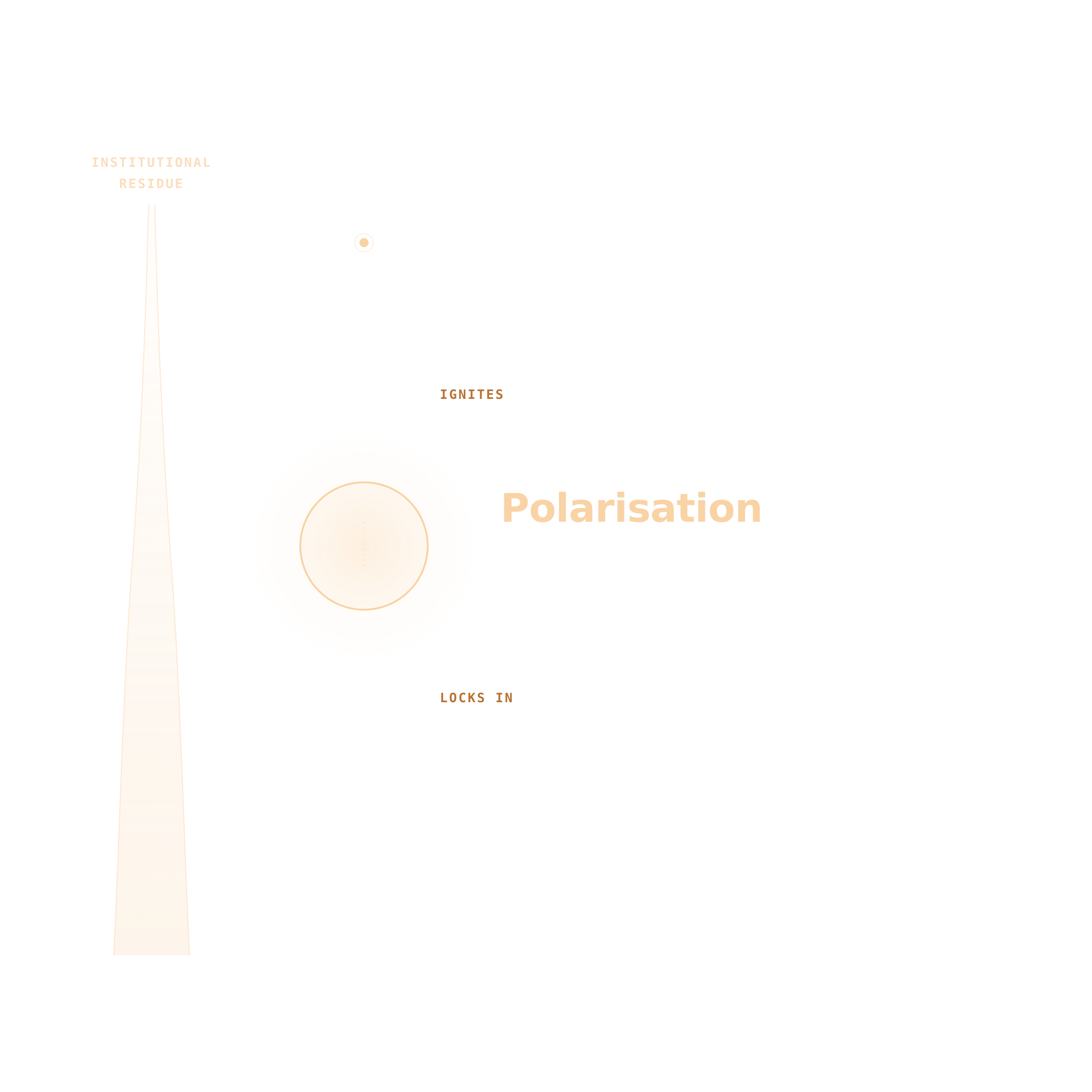
The institutional middle collapses. The distribution bifurcates into opposing extremes.
Polarisation emerges because moderate positions are the least stable configurations in a shifting environment. Moderate behaviour requires all four forces to hold simultaneously, and a shift in one destabilises the others. The strongest dependence is on the environmental signals each actor receives from the population around them. As those signals shift, moderate positions become identity-costly before extreme positions do, because extreme positions require fewer forces in agreement. The rate at which the middle drops out peaks when the population is split evenly and approaches zero near the extremes. Moderate positions do not slowly fade. They collapse, because the conditions sustaining them collapse first. The distribution bifurcates into two extremes, often asymmetric in size but always asymmetric in intensity.
When this phase is reached
The population's distribution has bifurcated. Moderate positions have become identity-costly. The institutional middle, the bridge between camps, is no longer available. Reversal cost rises sharply here. Once positions harden into identity, the cost of rebuilding the middle exceeds the cost of letting institutionalisation complete.
The new state locks in through laws, infrastructure, and norms.
Institutionalisation is what happens when the new arrangement embeds itself into the conditions facing every actor. Laws change. Infrastructure is built around the new state. Professional norms reorganise to treat it as default. Each layer of embedding accumulates as institutional residue. Once the residue is large enough, the new state is the default outcome for the population without any active force sustaining it. Reversal then requires unwinding the residue across every actor simultaneously, changing all four forces in each individual rather than one force across many. That structural asymmetry is what makes reversal so costly, and why the reverse path so rarely completes.
When this phase is reached
The new state has become the default. Laws, infrastructure, and norms hold the cascade in place. Reversal requires decades, when it occurs at all. This is the binding state of the asymmetric-reversibility claim. The forward path took weeks or months. The reverse path takes years or generations.
Domain-invariant · Biological · Artificial · Hybrid
Every cascade framework in the existing literature stops at description. It names a pattern, maps a mechanism, or documents an empirical regularity. None derives the cascade from a more fundamental law, none validates it across domains at scale, and none makes it operational for researchers and practitioners working outside the domain where it was first observed. UCT does all three. The twelve advantages below are not features added to an existing framework. They are consequences of starting from a stronger foundation.
The three phases of a cascade are not assumed. They are derived from the multiplicative decision architecture of IADT. Ignition follows from threshold dynamics. Polarisation follows from the instability of moderate configurations. Institutionalisation follows from the accumulation of institutional residue. Each phase has a causal foundation, not an empirical label.
The cascade derives from the same equation that governs each individual decision. The four forces operating at the micro level produce the phase dynamics at the macro level without an intervening black box. A researcher using UCT can trace any macro outcome to the micro mechanism and locate the point of leverage.
The same three phases hold whether the cascading actors are human beings, AI systems, or hybrid human-AI teams. The forces differ in their instantiation. The interaction structure does not. Findings from one substrate transfer to another wherever the ISP criterion is satisfied, and researchers can apply UCT across domains without rebuilding from first principles.
UCT sits between IADT at the micro level and ISP at the meta level. Researchers adopting UCT enter an integrated three-law structure. IADT specifies what each actor does. UCT specifies what aggregate behaviour follows. ISP specifies when analogies across domains are structurally valid. The three laws extend each other's empirical reach.
UCT makes specific, dateable predictions. It predicts when a cascade will transition between phases, which segment of the population polarises first, and the asymmetric reversibility ratio in any confirmed cascade. These predictions are falsifiable in advance, not reverse-engineered from outcomes already observed.
Most cascade frameworks are qualitative by design. UCT is not. The polarisation kernel and the institutional residue function give researchers numbers to fit, forecasts to test, and specifications to falsify. The cascade becomes a quantitative object, not a conceptual one.
Most cascade frameworks model build-up only. UCT specifies both directions. The forward path follows Ignition through Polarisation to Institutionalisation. The reverse path is governed by the institutional residue, which makes it slower by a factor of two to six in confirmed cases. The cost of any proposed intervention is therefore quantifiable before action is taken.
The three phases carry different intervention logics. Pre-Ignition, the population is sensitive to shifts that can prevent the cascade. During Polarisation, the bridge between camps is the highest-value point of intervention. Once Institutionalisation is reached, reversal requires a counter-cascade. UCT maps the intervention window to the phase.
UCT specifies what would disprove it. Find a cascade that reaches Institutionalisation without passing through structural bifurcation, or one that fully reverses on the same timescale as its forward path. Either outcome is an informative finding. Most cascade frameworks do not state what would constitute failure. UCT does.
130,000 data points across four domains. Public health, financial markets, political institutions, and AI deployment. The three-phase signature appeared in every confirmed case. Forward-to-reverse asymmetry ranged from 2:1 to 6:1. The results are independently replicable from publicly available data.
Three mathematical objects produce the full cascade specification. A multiplicative composition rule, a polarisation kernel, and a residue accumulation function. Together they generate the phase structure, the phase transitions, the asymmetric reversibility, and the domain invariance. The existing literature requires multiple separate qualitative frameworks to describe what UCT derives from one equation.
The working paper is deposited on Zenodo with permanent DOI. Independent researchers can replicate every result, extend the empirical record, or attempt falsification using the published methodology. No institutional access required.
Five research traditions have approached the cascade problem. Each one identified something real. Threshold models captured ignition dynamics. Opinion dynamics captured bifurcation. Path dependence captured lock-in. But each tradition stopped at the boundary of its own domain, treated its core mechanism as a given, and left the micro-to-macro link unspecified. None derived the three phases from a single structural foundation. UCT does. The five entries below show where each tradition stops and why UCT is the stronger alternative.
Granovetter (1978) · Watts (2002, 2004)
Granovetter modelled collective behaviour as the aggregation of individual thresholds. Each individual joins an action once enough others have already joined. The threshold itself is a primitive, given rather than derived. Watts extended the framework onto random networks, showing that cascade size depends on the joint distribution of thresholds and network topology. Both treat the cascade as a percolation event that fires once sufficient low-threshold individuals act first.
The aggregation problem at the macro scale. The mathematics of how individual heterogeneity produces collective dynamics. The role of network topology in cascade propagation. The empirical observation that some events ignite and others fail.
The threshold is exogenous. The model does not specify why one individual carries a low threshold and another a high one. The cascade is treated as a binary event rather than a sequential three-phase process. Threshold models end at Ignition. Polarisation, Institutionalisation, and the asymmetric reversibility between them are outside the frame.
The threshold is derived from the multiplicative configuration of IADT. An individual's threshold is the configuration at which one of the four forces sits near zero, so that a small change flips the multiplicative product across the action boundary. The cascade then continues into Polarisation and Institutionalisation, with institutional residue R accumulating across phases and producing the asymmetry between forward and reverse paths.
Bak, Tang, and Wiesenfeld (1987) · Bak (1996)
Bak and colleagues showed that many natural processes organise themselves to a critical state at which small triggers can produce avalanches of any size. The sandpile model demonstrated that complex processes can evolve to the edge of stability without external tuning, producing power-law distributions of event sizes. The framework has since been applied to earthquakes, forest fires, neural activity, and financial market crashes.
The structural insight that cascade-prone processes are not unstable accidents but stable configurations. The power-law distribution of cascade sizes. The empirical observation that small triggers can produce arbitrarily large effects.
Self-organised criticality is a physical metaphor. It describes the statistical signature of cascade-prone processes without naming the decision-making mechanism that produces it. The sandpile is direction-neutral: grains can be added or removed with no inherent asymmetry, so reversibility is symmetric in the model. There is no phase structure beyond the avalanche itself.
The sandpile is replaced by the multiplicative architecture of IADT as the decision-making mechanism. The criticality observed in cascade-prone processes is a consequence of the multiplicative form, because small changes to one of four interacting forces produce qualitative changes in the outcome. UCT adds the three-phase structure and derives asymmetric reversibility from the multiplicative form, rather than borrowing it from physics.
DeGroot (1974) · Friedkin and Johnsen (1999) · Schelling (1971, 1978)
DeGroot modelled opinion formation as repeated weighted averaging among neighbours in a social network. Friedkin and Johnsen added actors with fixed initial positions, producing partial consensus rather than full convergence. Schelling showed that mild individual preferences for similar neighbours produce strong macro-level segregation even when the underlying individuals are tolerant. All three connect individual preferences to macro patterns through repeated local interaction.
The aggregation problem at the population scale. The mathematics of network-mediated influence. The non-linearity of preference aggregation, particularly in Schelling's segregation work. The empirical observation that populations do not converge cleanly to single positions.
Initial preferences are exogenous in all three approaches. The mechanism that generates them is outside the model. None specifies why the middle of a distribution collapses rather than slowly fading. Bifurcation is not the centre of the analysis. Asymmetric reversibility is absent.
The bifurcation is specified by the polarisation kernel P²(1−P). At the middle of the distribution, conditions for moderate behaviour are least stable under social feedback, because the multiplicative supports require continued moderate behaviour by others. What appears as gradual fading is in fact collapse, a derived consequence of the multiplicative architecture, not an empirical pattern. UCT places Polarisation in a phase structure, connecting it to Ignition before and Institutionalisation after.
Tajfel and Turner (1979) · Turner et al. (1987)
Tajfel and Turner proposed that individuals derive part of their self-concept from group membership, and that this identity shapes their behaviour toward in-group and out-group members. The minimal group paradigm showed that even arbitrary group categorisations produce systematic in-group favouritism. Subsequent work demonstrated that identity-aligned positions become resistant to change, because reversal carries identity costs in addition to opinion costs.
The role of group membership in shaping individual behaviour. The empirical observation that identity-aligned positions are sticky. The asymmetry between in-group and out-group treatment. The cost structure of changing identity-aligned beliefs.
Social Identity Theory describes the consequences of identity formation once it has occurred. It does not model the mechanism by which a population splits into in-groups and out-groups in the first place. The phase structure is implicit. Identity is treated as a setting rather than as the second phase of a three-phase cascade. The theory was developed in a biological substrate and has no formal extension to artificial or hybrid ones.
The bifurcation is a derived consequence of the multiplicative architecture. Identity-locking of the kind Tajfel and Turner observed is the structural reason why Polarisation is harder to reverse than Ignition, and why reversal cost rises sharply as Polarisation completes. UCT extends the dynamics across substrates. Identity-like positional commitments appear in artificial processes and in hybrid ones where policy fractures along identity lines rather than technical ones, and the same polarisation kernel applies.
DiMaggio and Powell (1983) · David (1985) · Arthur (1989) · Pierson (2000, 2004)
DiMaggio and Powell identified three mechanisms by which organisations come to resemble each other under uncertainty. David analysed the QWERTY keyboard as a case of path-dependent lock-in driven by historical accident rather than functional superiority. Arthur formalised increasing-returns dynamics that produce technology lock-in. Pierson extended path dependence to political institutions, showing how reversal costs compound across electoral cycles. Together, the work documents that institutional patterns, once locked in, resist reversal.
The mechanisms of institutional lock-in. Mimetic pressures, increasing returns, network effects, sunk costs, infrastructure entrenchment. The empirical observation that institutional patterns persist beyond their initial rationale. The phenomenon of reversal cost rising over time.
Multiple distinct mechanisms are treated as parallel explanations rather than aspects of a single structural feature. The micro-macro link is implicit in each. Asymmetric reversibility is documented empirically but not derived. The Ignition and Polarisation phases that precede Institutionalisation are outside the frame.
A single structural mechanism replaces the cluster. Institutional residue R is the persistent environmental factor inside each individual's IADT configuration, accumulating as the cascade progresses. The mimetic pressures, increasing returns, and sunk costs of the prior literature are aspects of this single residue function. UCT makes the micro-macro link direct: the residue at the macro scale is the same R that appears in each individual's IADT equation. Asymmetric reversibility is a derived consequence, not an empirical observation. Reversal requires all four IADT forces to be restored in each individual, against an R that has accumulated mass.
UCT was tested across four cascade domains spanning biological, artificial, and hybrid substrates. The three-phase signature was found in every case examined. The forward-to-reverse asymmetry ranged between two and six. The empirical record is published with permanent DOIs and is reproducible from source.
Ignition, Polarisation, Institutionalisation. The same structure appears in every confirmed case.
Public health, financial markets, political systems, and artificial intelligence.
The reversal cost is two to six times the forward cost. The ratio is the cascade's empirical validated pattern.
Open replication. Paper deposited on Zenodo with permanent DOIs.
Most cascade frameworks do not specify their own falsification conditions. UCT does. The criterion is concrete, dated, and reproducible. A confirmed case marks a boundary, not an ending. The boundary is itself a finding, and the work continues from there.
If a cascade reaches institutionalisation without passing through structural bifurcation of the population, the three-phase model is wrong for that domain. If a fully institutionalised cascade reverses on the same timescale as it formed, the asymmetric-reversibility claim is wrong. Either outcome is informative.
UCT governs how individual decisions aggregate into institutional outcomes. Downward, it connects to IADT, which specifies what each actor decides before anything cascades. Outward, it connects to ISP, which specifies when the same cascade logic transfers across substrates and domains. UCT is the connective law. Without IADT beneath it, there is no mechanism. Without ISP beside it, there is no transfer.

Action under complexity is determined by the dynamic interaction of four forces. The interaction itself is the mechanism. Additive models systematically under-perform because they cannot represent it.

A criterion for when a structural pattern recurs across scales and domains. The pattern transfers only where structural identity holds.
Patrick Mehrhoff is a German entrepreneur, independent researcher, AI engineer, and author. He is the author of the three original theories that constitute the Mehrhoff Research Program. He built the work the studio carries.
Most practitioners spend a career inside one domain. He worked as a practitioner at six of the frontiers that redefined how society organises information, money, and value over the last two decades. The consumer internet, Swiss fintech, European monetary policy, Southeast Asian financial publishing, institutional crypto assets, and the first wave of applied AI.
The same structural observation appeared at every frontier. By 2019, on a whiteboard at crypto infrastructure provider Wyden in Zurich, the pattern had become visible to itself. It did not yet have a name. Four years before any AI language model became publicly available, the complete logic of the Three Laws of Decision-Making was already on the whiteboard.
The studio was built from Bangkok, without institutional affiliation and without external funding. The Rubens workshop model defines how it operates. The founder sets the intellectual direction at every decisive step. The tools and collaborators execute within it.

Tested against nine foundational scholars, three of them Nobel laureates, and across fifteen structural dimensions. Every cell is independently challengeable.
Every dimension independently challengeable.
Most frequently cited as predecessors.
Among the nine scholars tested.
Confirmed across all nine scholars.

The three laws describe the same multiplicative structure that governs decisions across scales. What each audience recognises in them is different. Each doorway below opens into the same set of laws, framed for the way you are most likely to find your own work inside them.

The literature in your field has been reporting tail-failure for decades. Outliers, noise, model misspecification. The three laws name a different culprit. The structural form of the model itself. Read the laws and find the place where the assumption you never questioned has been doing the work all along.

Every senior decision-maker has watched a model work on average and break where the decision mattered. The three laws name what is happening. The breakage is not an edge case the model failed to anticipate. It is the multiplicative architecture finding its zero. Read the laws and the pattern beneath every model break of your career becomes legible at once.

Each major institutional cascade of the past fifteen years was investigated as if it were unique. The reports document different operational failures in different sectors. The three laws read across the reports and recognise one structural pattern. Read the laws and the recurrence stops looking like coincidence.

Every philosophical tradition that has tried to describe the world has eventually arrived at the same conclusion. The three laws turn the conclusion into a working structural explanation. Decisions form. They cascade. Their patterns transfer across scales. Read the laws the way our studio reads them.
Most foundational research is finished before a student arrives. The three laws sit early enough in their life that the field around them is still to being created. A graduate student who reads them now enters a body of work inside its formative window. The reading path is curated for entry from any quantitative or social-science background.

Universities train within additive frameworks. Journals review within them. Regulators write rules under them. Funders evaluate against them. The three laws name the structural assumption beneath the entire foundational layer. It has been invisible because no curriculum, no review, no framework has ever required it to be examined. Read the corpus and the link your institution has been operating without becomes legible.
The first program states the architecture and demonstrates the laws that govern it. The second tests those laws against the empirical record of human decision-making. Together they establish the studio's canonical core and its first empirical substantiation. Further programs are in active preparation.
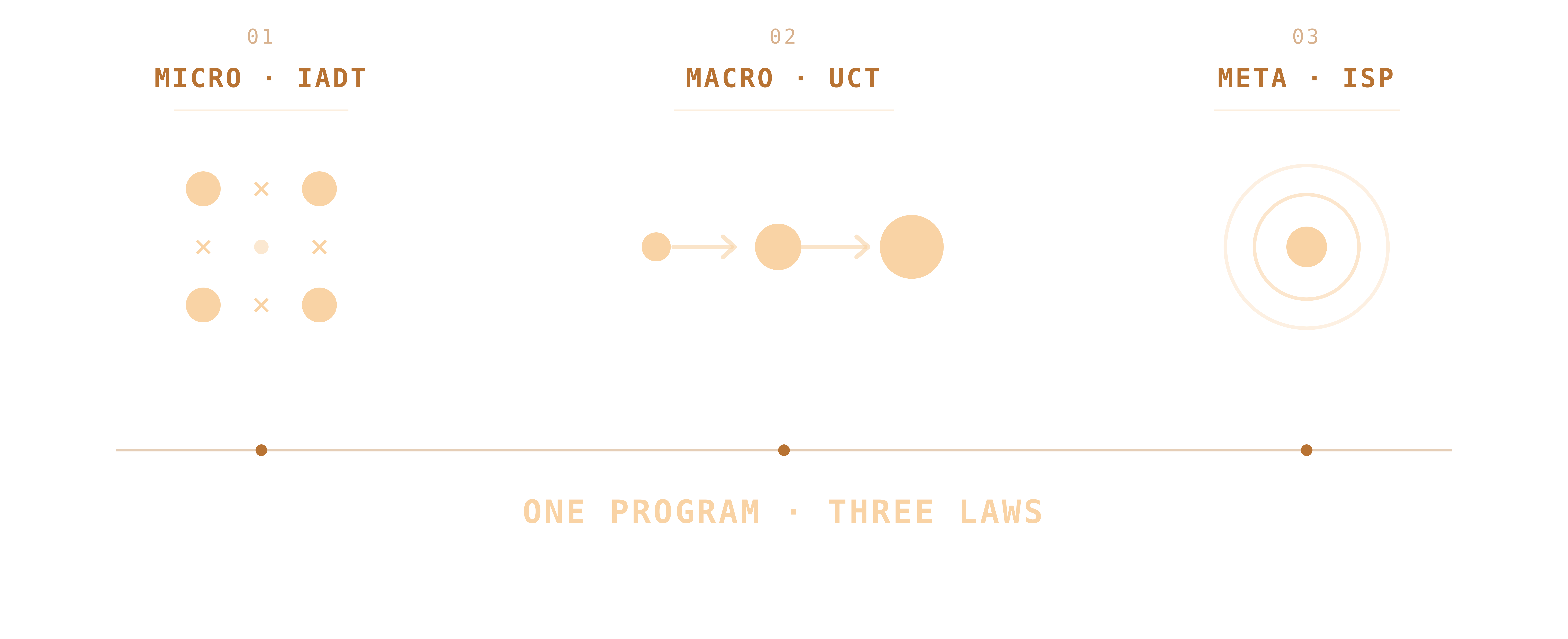
The three laws at the micro, macro, and meta scales, derived and stated formally. Plus the empirical evidence that the multiplicative architecture holds across biological, artificial, and hybrid substrates. Every paper in every other program traces its structural claims back to this canonical core.
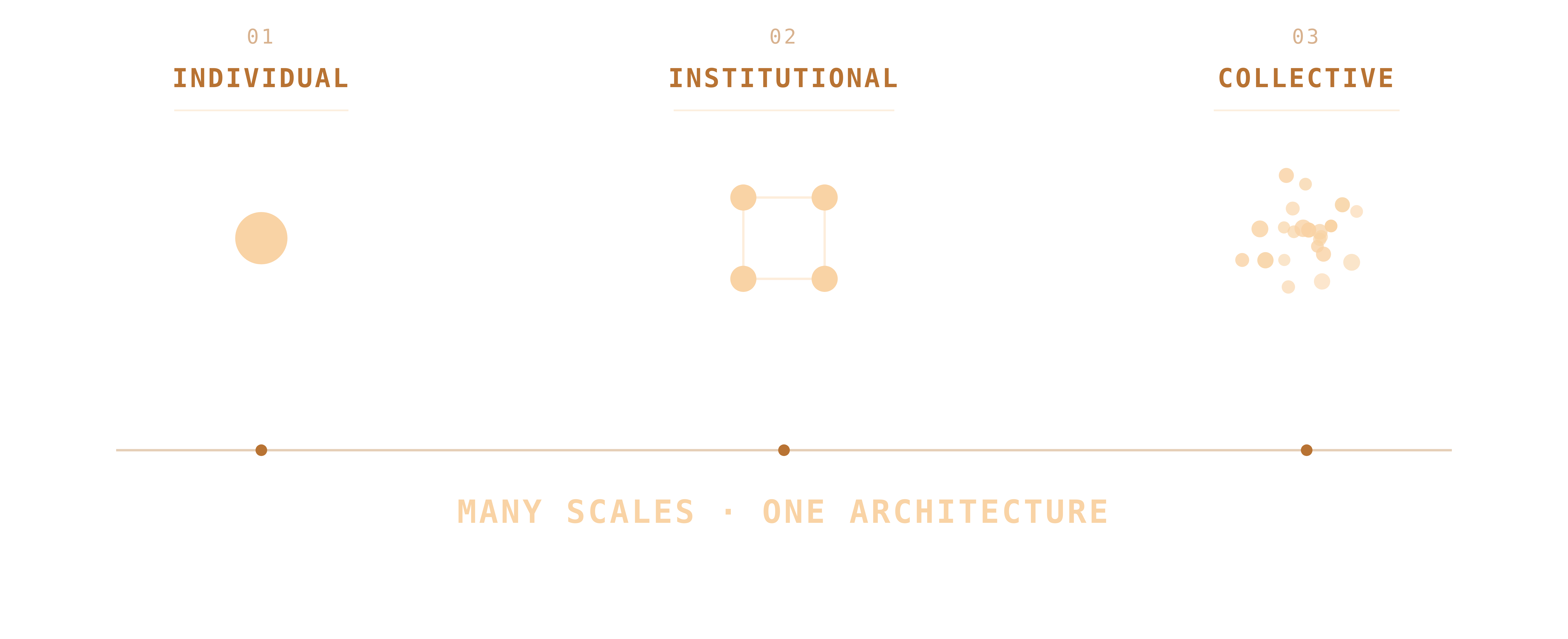
The laws tested against the empirical record from every sector, industry, and discipline where humans make decisions. From financial risk to clinical judgement to educational selection to electoral behaviour, the same multiplicative architecture governs the outcome. Every test in the program substantiates the structural finding the foundational program advanced.
The first sketch of the Three Universal Laws. Drawn four years before any AI language model became publicly available.
Sketched at an office in Zurich. The board maps the direction of the markets, the forces driving them, the audiences they affected, the problems those audiences encountered, and the responses the market was developing. The structural logic that became the First, Second, and Third Laws is already on the board, in the language of practice.

Mehrhoff Research operates outside academia and outside industry. An independent science and research studio with no external funding, no board, and no university partnership. Founded 2019 in Zurich, domiciled in Tallinn, run from Bangkok.
The work is published open access. Every paper passes adversarial peer review before deposit. Every claim names the empirical conditions under which it would be falsified. Every citation traces to a primary source. The standard is not the institution. The standard is the work.
Deposited on Zenodo, permanently archived.
Data points analysed across all empirical validations.
Foundational and human decision-making.
No paywall, no journal embargo.

A horizon decades away. The daily practice of moving toward it. Seven principles the studio holds itself to, with or without anyone looking. Five codes the studio answers to when no external authority requires them. Each statement enforced internally. Each verifiable from outside.

Vision and mission, stated directly. What the studio is working toward, and what it does today.

Seven standards held against every paper, every conversation, every relationship the studio enters. Decision-making, rigour, independence, transparency, originality, curiosity, and courage.

Self-regulated science. Published standards, open methods, full results regardless of what they show.
Press, academic peers, conference organisers, policy bodies, industry practitioners, and readers reach the studio here.
Six formats, from public keynote to closed doctoral seminar. The full range is welcome; the substance of the questions decides the invitation.
Four positions, from visiting researcher to fellowship, with two scheduled per calendar year. A residency produces sharper work than a single talk because the conversation extends.
Press kit with bios, headshots, and topic briefs is ready to download. Lectures, learning materials, and the architecture itself are licensable.