
Patrick Mehrhoff is the founder of Mehrhoff Research, an independent science and research studio. He is a German entrepreneur, independent researcher, and AI engineer, and the author of the Three Laws of Decision-Making. The research originated in practitioner observation, with the logic first sketched on a whiteboard in Zurich in 2019, four years before any AI language model became publicly available. His prior career spans more than fifteen years outside Germany, with senior roles at MoneyPark, acquired by Helvetia, and Crypto Finance, acquired by Deutsche Börse.

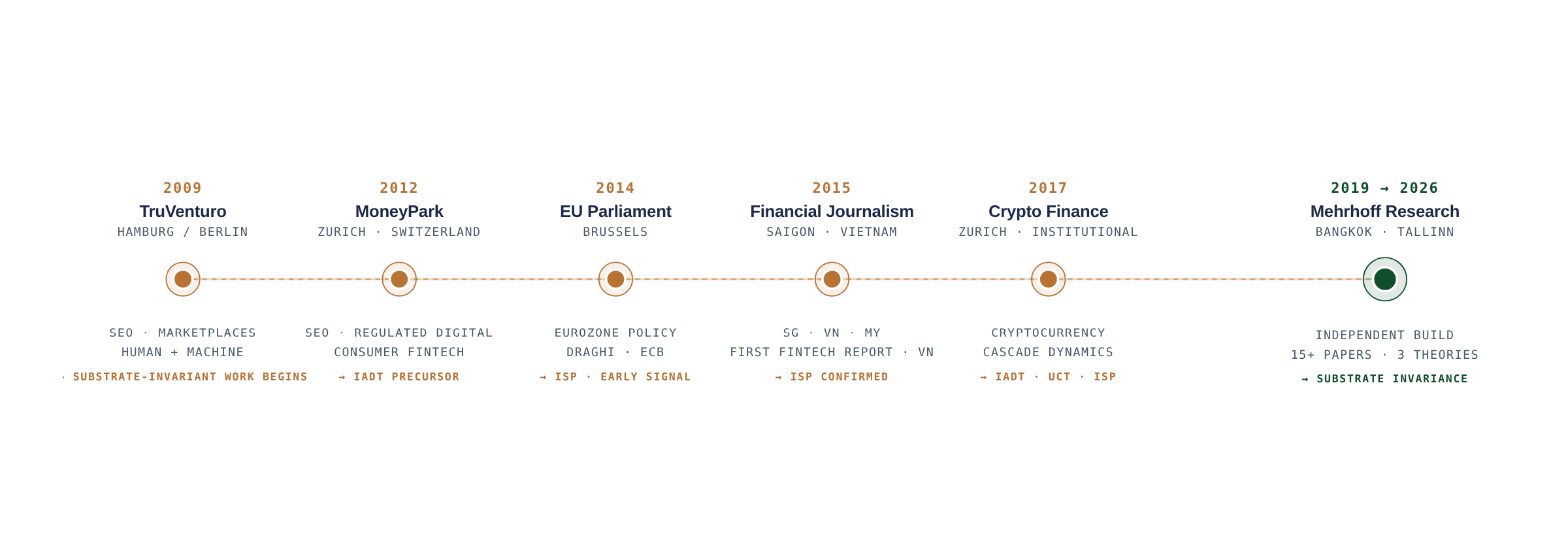
Six frontiers in seventeen years. Consumer internet, Swiss fintech, European monetary policy, Southeast Asian financial markets, institutional cryptocurrency, and the independent research programme. Each one at a different intersection of technology, regulation, and capital. Each one requiring the practitioner to hold three scales simultaneously. What governs the individual decision. What governs the system those decisions produce. Whether the same structure holds across every domain it appears in. These question did not have a formal structure until a whiteboard in Zurich in 2019. By then the practitioner had been working the problem for a decade.
Patrick Mehrhoff is a German entrepreneur, independent researcher, AI engineer, and author. He is the author of the three original theories that constitute the Mehrhoff Research Program. He built the work the studio carries.
Most practitioners spend a career inside one domain. He worked as a practitioner at six of the frontiers that redefined how society organises information, money, and value over the last two decades. The consumer internet, Swiss fintech, European monetary policy, Southeast Asian financial publishing, institutional crypto assets, and the first wave of applied AI.
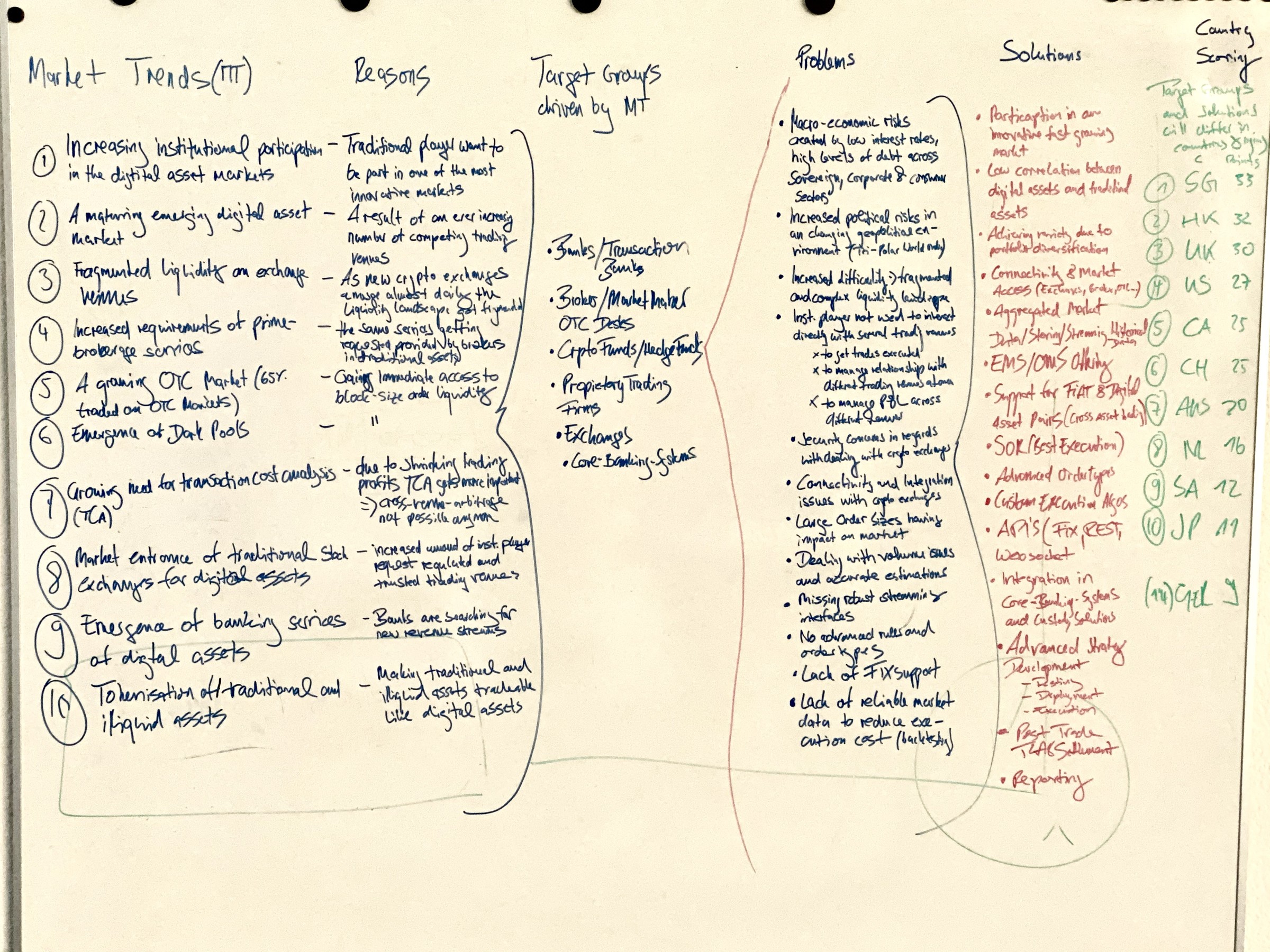
The same structural observation appeared at every frontier. By 2019, on a whiteboard at crypto infrastructure provider Wyden in Zurich, the pattern had become visible to itself. It did not yet have a name. Four years before any AI language model became publicly available, the complete logic of the Three Laws of Decision-Making was already on the whiteboard.
The studio was built from Bangkok, without institutional affiliation and without external funding. The Rubens workshop model defines how it operates. The founder sets the intellectual direction at every decisive step. The tools and collaborators execute within it.

Six frontier roles in seventeen years across two continents. Each one at the leading edge of a different technological and economic transformation. The research program was not designed in advance and then validated. The observations came first. The framework formalised what seventeen years of practice had been demonstrating.

He started in 2009 at TruVenturo, the Hamburg incubator that, alongside Rocket Internet, was building the consumer-internet ventures that defined the early German startup ecosystem. The work was ecommerce, marketplaces, and the early architecture of the modern internet economy, at the moment those structures were being assembled rather than maintained. He led SEO across the portfolio at scale, engineering every page to satisfy two readers at once. A human arriving with a question. A search algorithm ranking the answer. Same words, same screen, same moment, satisfying both. He had been working substrate-invariant from the first frontier, fifteen years before the research program would give it a name.
He joined MoneyPark in its founding year, 2012, when the company was bringing online comparison technology to Swiss mortgages, a sector still dominated by bank branches and tied broker networks at the time. He led SEO from year one, building the digital acquisition channel from zero through to Helvetia's acquisition in 2016, by which point MoneyPark was Switzerland's largest independent mortgage broker. The dual-reader discipline carried from the German incubator now had a third reader to satisfy. The same mortgage content had to work for a Swiss consumer comparing loan options, a search algorithm ranking that content against thousands of competing pages, and a financial regulator who would later read the content under consumer-protection lenses. Three readers. One page. One structure. He learned how regulated industries metabolise digital transformation, and what adoption actually looks like when an incumbent sector has to compete with a transparent platform. The investor-segmentation work he developed during this period was the practitioner precursor to the Integrated Action-Driver Theory. IADT later formalised the observation that decisions are made under multiplicative interactions of environmental forces, temporal triggers, motivational states, and cognitive filters, collapsing entirely if any one factor reaches zero.
He moved to Brussels in late 2014 as digital advisor to a sitting Economist Member of the European Parliament, taking up a role being defined inside an institution reckoning with the most turbulent period of the Eurozone since the single currency's founding. From the chamber floor, he watched Mario Draghi announce the European Central Bank's expanded asset purchase program. From the corridors afterwards, he watched the institution try to make sense of what had just been done to it. Some announcements an institution can absorb. Others overwhelm everything in the room, regardless of resources thrown at the problem. The pattern that linked Swiss mortgage distribution to European monetary policy across radically different scales, governed by the same underlying logic, was the early signal that produced the Identical Scale Principle.
He moved to Saigon in 2015 to join a regional financial journalism platform covering Singapore, Vietnam, and Malaysia, almost a decade before institutional capital began calling Southeast Asia the future. He built and published the first formal Fintech Industry Report on Vietnam and Indonesia during that period. No prior report existed to update. No framework existed to adopt. He produced both, mapping the early shape of an emerging-market financial system at the precise moment its trajectory was being set. From the same Saigon desk, he wrote his first article on Bitcoin as a likely future reserve currency, building on the Draghi announcement he had watched from the Parliament floor the year before. More than a decade later, the thesis is no longer fringe. The region taught him from inside, not as a Western observer reading reports from Singapore hotel rooms, but as an operator in markets the formal sector had not yet reached. The Asia perspective that runs through the research program is built on residency. Not on visits. The third repetition of the same pattern, with the same forces shaping decisions in Southeast Asian emerging markets that had already shaped them in Swiss fintech and European monetary policy, confirmed the cross-scale identity claim that became the Identical Scale Principle.
He returned from Asia in 2017 to join the founding team at Crypto Finance, the Zurich-based firm establishing itself that year as the first FINMA-regulated provider of trading, custody, and investment services for digital assets, and the institutional bridge between traditional Swiss banking and the emerging crypto asset class. The two years that followed were spent inside an institutional frontier that did not yet exist when he arrived, watching an asset class move at speeds traditional financial markets never reach. Cascade dynamics that take a generation to play out in equities played out in months in crypto. The 2018-2019 bear market alone produced more empirical cascade data than the previous twenty years of equity market history. Crypto Finance was later acquired by Deutsche Börse, validating the thesis that had defined the founding years. The whiteboard at Wyden in Zurich in 2019 was where the three observations crystallised. IADT, UCT, and ISP became visible together as a single multiplicative structure, not three separate observations that happened to relate to each other.

He launched Mehrhoff Research in 2019 as the independent science research initiative formalising the three theories of decision-making that had emerged from a decade of practitioner work across consumer internet, regulated fintech, monetary policy, emerging markets, and institutional cryptocurrency. Mehrhoff Digital was incorporated in Tallinn in 2022 under Estonian e-residency as the consultancy and holding entity for the independent research practice. The institutional address is Tallinn. The studio is in Bangkok. More than fifteen peer-reviewed papers were deposited openly on Zenodo with permanent DOIs across the five years that followed. A validation set of more than 130,000 data points was assembled across multiple substrates. By 2026, the science and research studio was established. The work had demonstrated empirically that the same structural laws of decision-making operate across biological, hybrid, artificial, and physical substrates. The 2019 whiteboard had been proven right by the work that followed.



Patrick Mehrhoff has been based outside Germany for seventeen years. The research program was built across three continents, a dozen countries, two acquisitions, one pandemic, and a whiteboard in Zurich. The observations that produced the three laws came from learning by doing, building and testing, and operating inside the systems the research would later describe. No dataset of that kind can be assembled from a desk.

Each institution teaches differently, and he has attended twenty-one of them. Not just for what each covers but for how it decides to teach it. Which methods it trusts. Who holds the knowledge in the room. Whether the person at the front has ever done the thing they are teaching, a variable few curricula make visible. He left with credentials from all twenty-one and a comparison that is still running. The notes are being put to use.





















The studio's purpose is to advance science for the benefit of humanity. That is not a slogan he tolerates; it is the actual reason he does the work. It is also the reason he refuses to do the work in the diminished form that institutional academic life often requires. A researcher who never leaves the laboratory does not produce the kind of observations the laws of decision-making depended on. A researcher who has never put their own capital behind a conviction does not understand the same things about decision under uncertainty that someone who has put their own capital at risk understands. A researcher who has never lived in the markets they are studying produces a different quality of insight than someone who has.
So he has lived the life the work required, and he has lived it with intention. He has based himself in Asia for almost five years because more than half of the world's population lives here, and any theory of decision-making that does not understand this region is incomplete. He has travelled when travel served the work, and he has stayed put when staying served it. He has kept his body in working condition because the work demands stamina he cannot otherwise sustain. He has read widely outside the disciplines his work is closest to, because foundational claims require the perspective only breadth produces. He has made friendships across cultures that have refined his understanding of what the work is for. He has done all of this not as recreation alongside the work, but as the conditions under which the work is possible.
He has something to say to other researchers and practitioners considering whether to follow a path closer to the one he has taken. The conventional advice in both worlds is that serious work requires a narrow life. You specialise. You stay close to your field. You progress through the channels the field recognises. You attend the right conferences. You let your career be shaped by the institutions that pay your salary. This advice produces a particular kind of work, much of which is genuinely valuable, but it does not produce the kind of work that requires conditions outside the institution.
If your work is the second kind, the path is harder, but the path is also more interesting.

Decision outcomes are governed by structural forces, not by stable attributes. The same multiplicative logic recurs at three scales and across domains.

Action under complexity is determined by the dynamic interaction of four forces. The interaction itself is the mechanism. Additive models systematically under-perform because they cannot represent it.

How individual decisions aggregate into institutional outcomes through three sequential phases. Ignition. Polarisation. Institutionalisation.

A criterion for when a structural pattern recurs across scales and domains. The pattern transfers only where structural identity holds.
Tested against nine foundational scholars, three of them Nobel laureates, and across fifteen structural dimensions. Every cell is independently challengeable.
Every dimension independently challengeable.
Most frequently cited as predecessors.
Among the nine scholars tested.
Confirmed across all nine scholars.

The three laws describe the same multiplicative structure that governs decisions across scales. What each audience recognises in them is different. Each doorway below opens into the same set of laws, framed for the way you are most likely to find your own work inside them.

The literature in your field has been reporting tail-failure for decades. Outliers, noise, model misspecification. The three laws name a different culprit. The structural form of the model itself. Read the laws and find the place where the assumption you never questioned has been doing the work all along.

Every senior decision-maker has watched a model work on average and break where the decision mattered. The three laws name what is happening. The breakage is not an edge case the model failed to anticipate. It is the multiplicative architecture finding its zero. Read the laws and the pattern beneath every model break of your career becomes legible at once.

Each major institutional cascade of the past fifteen years was investigated as if it were unique. The reports document different operational failures in different sectors. The three laws read across the reports and recognise one structural pattern. Read the laws and the recurrence stops looking like coincidence.

Every philosophical tradition that has tried to describe the world has eventually arrived at the same conclusion. The three laws turn the conclusion into a working structural explanation. Decisions form. They cascade. Their patterns transfer across scales. Read the laws the way our studio reads them.

Most foundational research is finished before a student arrives. The three laws sit early enough in their life that the field around them is still to being created. A graduate student who reads them now enters a body of work inside its formative window. The reading path is curated for entry from any quantitative or social-science background.

Universities train within additive frameworks. Journals review within them. Regulators write rules under them. Funders evaluate against them. The three laws name the structural assumption beneath the entire foundational layer. It has been invisible because no curriculum, no review, no framework has ever required it to be examined. Read the corpus and the link your institution has been operating without becomes legible.
The first program states the architecture and demonstrates the laws that govern it. The second tests those laws against the empirical record of human decision-making. Together they establish the studio's canonical core and its first empirical substantiation. Further programs are in active preparation.
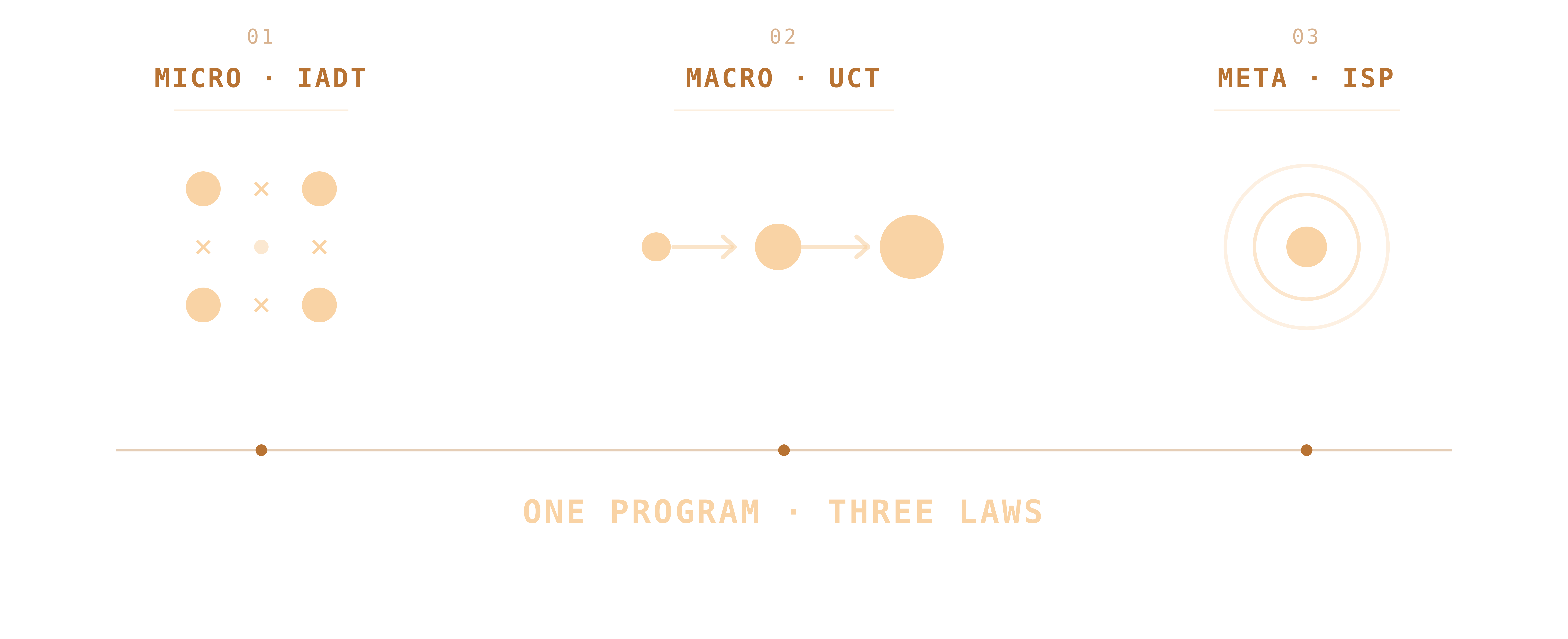
The three laws at the micro, macro, and meta scales, derived and stated formally. Plus the empirical evidence that the multiplicative architecture holds across biological, artificial, and hybrid substrates. Every paper in every other program traces its structural claims back to this canonical core.
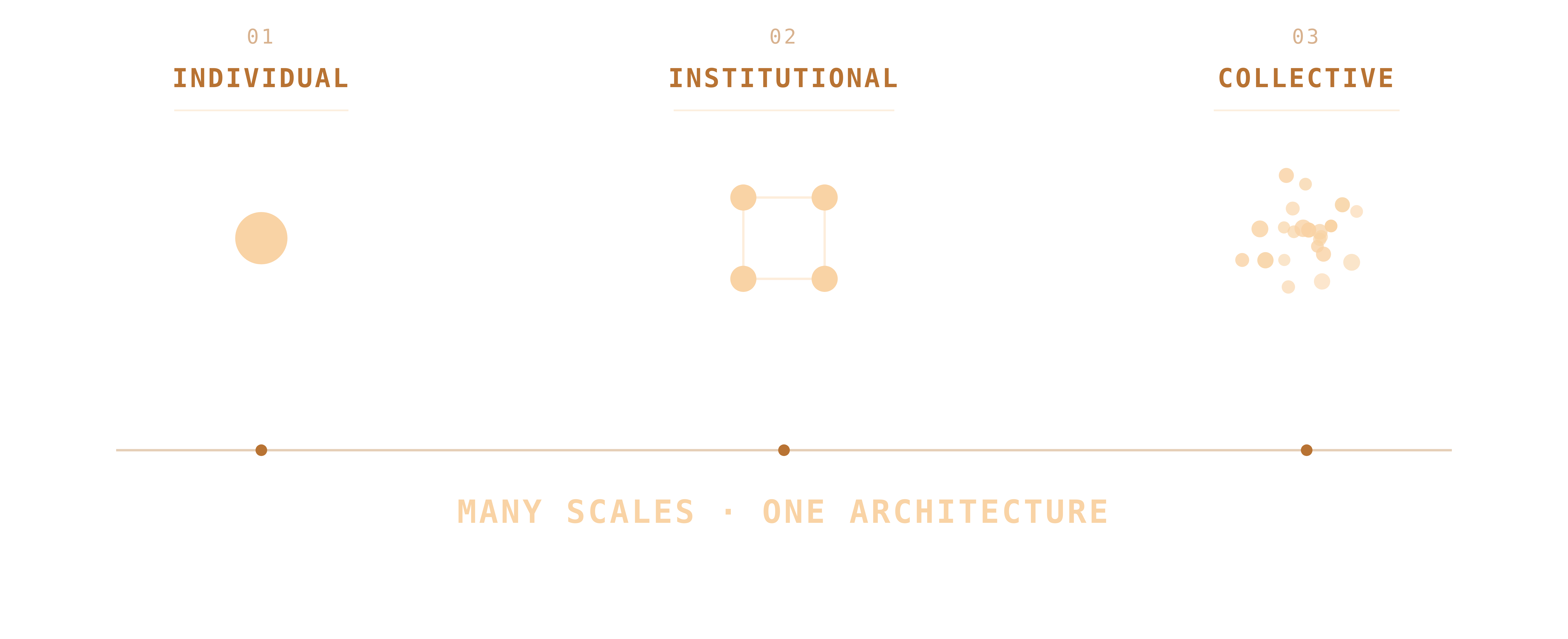
The laws tested against the empirical record from every sector, industry, and discipline where humans make decisions. From financial risk to clinical judgement to educational selection to electoral behaviour, the same multiplicative architecture governs the outcome. Every test in the program substantiates the structural finding the foundational program advanced.
The first sketch of the Three Universal Laws. Drawn four years before any AI language model became publicly available.
Sketched at an office in Zurich. The board maps the direction of the markets, the forces driving them, the audiences they affected, the problems those audiences encountered, and the responses the market was developing. The structural logic that became the First, Second, and Third Laws is already on the board, in the language of practice.
Mehrhoff Research operates outside academia and outside industry. An independent science and research studio with no external funding, no board, and no university partnership. Founded 2019 in Zurich, domiciled in Tallinn, run from Bangkok.
The work is published open access. Every paper passes adversarial peer review before deposit. Every claim names the empirical conditions under which it would be falsified. Every citation traces to a primary source. The standard is not the institution. The standard is the work.
Deposited on Zenodo, permanently archived.
Data points analysed across all empirical validations.
Foundational and human decision-making.
No paywall, no journal embargo.

A horizon decades away. The daily practice of moving toward it. Seven principles the studio holds itself to, with or without anyone looking. Five codes the studio answers to when no external authority requires them. Each statement enforced internally. Each verifiable from outside.

Vision and mission, stated directly. What the studio is working toward, and what it does today.

Seven standards held against every paper, every conversation, every relationship the studio enters. Decision-making, rigour, independence, transparency, originality, curiosity, and courage.

Self-regulated science. Published standards, open methods, full results regardless of what they show.
Press, academic peers, conference organisers, policy bodies, industry practitioners, and readers reach the studio here.
Six formats, from public keynote to closed doctoral seminar. The full range is welcome; the substance of the questions decides the invitation.
Four positions, from visiting researcher to fellowship, with two scheduled per calendar year. A residency produces sharper work than a single talk because the conversation extends.
Press kit with bios, headshots, and topic briefs is ready to download. Lectures, learning materials, and the architecture itself are licensable.