
Decision theory describes the behaviour of populations. It has never explained, with precision, why an individual acts at a given moment, or fails to. The Integrated Action-Driver Theory (IADT) is the first theory to do so, operationally and quantifiably. The same micro law applies equally to human actors, agentic AI, and the hybrid systems where both decide together.

The strongest test of the first law IADT is variety. If decisions multiply rather than add, the same pattern should appear across radically different domains. The cases below span banking, public health, and energy. Each had three forces at maximum and one at zero. The existing models predicted action in every case. The action never occurred.
2008
$22 tn US household wealth lost · 8.7 m jobs lost
Capital was abundant. Regulation was in place. Functional need to transact was acute. One force, the trust filter that converts available capital into actual lending, collapsed. Lending stopped, not slowed.
2020
7 m+ deaths globally · $16 tn US economic cost
The epidemiological evidence was strong. The political mandate was present. The functional need was clear. The temporal trigger response, the days lost between evidence and lockdown, brought the actionable factor toward zero. The cascade ran ahead of the decision.
2023
$42 bn withdrawn in 24 hours · $209 bn in failed bank assets
SVB's deposit base was abundant, regulatory capital was within range, and the bond portfolio was held to maturity. The interaction between concentrated depositors, unrealised bond losses, and the speed of digital withdrawal was multiplicative. The 2018 rollback of stress-testing for banks below $250 bn treated the four factors additively. One force at zero, the supervisory oversight that should have caught the combination of duration risk and concentrated deposits, collapsed the bank in 36 hours.
2010
11 lives lost · 4.9 m barrels spilled · $65 bn in BP costs
The Macondo well design was approved, the cement job was complete, and the rig crew was experienced. The interaction between cement integrity, pressure-test reading, blowout-preventer function, and time pressure was multiplicative. BP and the regulator treated the four factors additively. One filter at zero, the crew's reading of an ambiguous negative-pressure test under schedule and cost pressure, opened the path to the blowout that night.
Decision-making under complexity is shaped by four logically independent forces that operate at different scales and time horizons. Each force is necessary. None is sufficient on its own. The mechanism is not the forces themselves. It is the multiplicative interaction between them.
A collector arrives at Art Basel with the budget, the expertise, and genuine aesthetic resonance with a particular work. Three of the four forces are at maximum. The trusted advisor left the fair that morning, and the decision window closed without consultation. The temporal trigger is at zero. The additive model predicts a purchase. The multiplicative model predicts none. The painting stays on the wall.
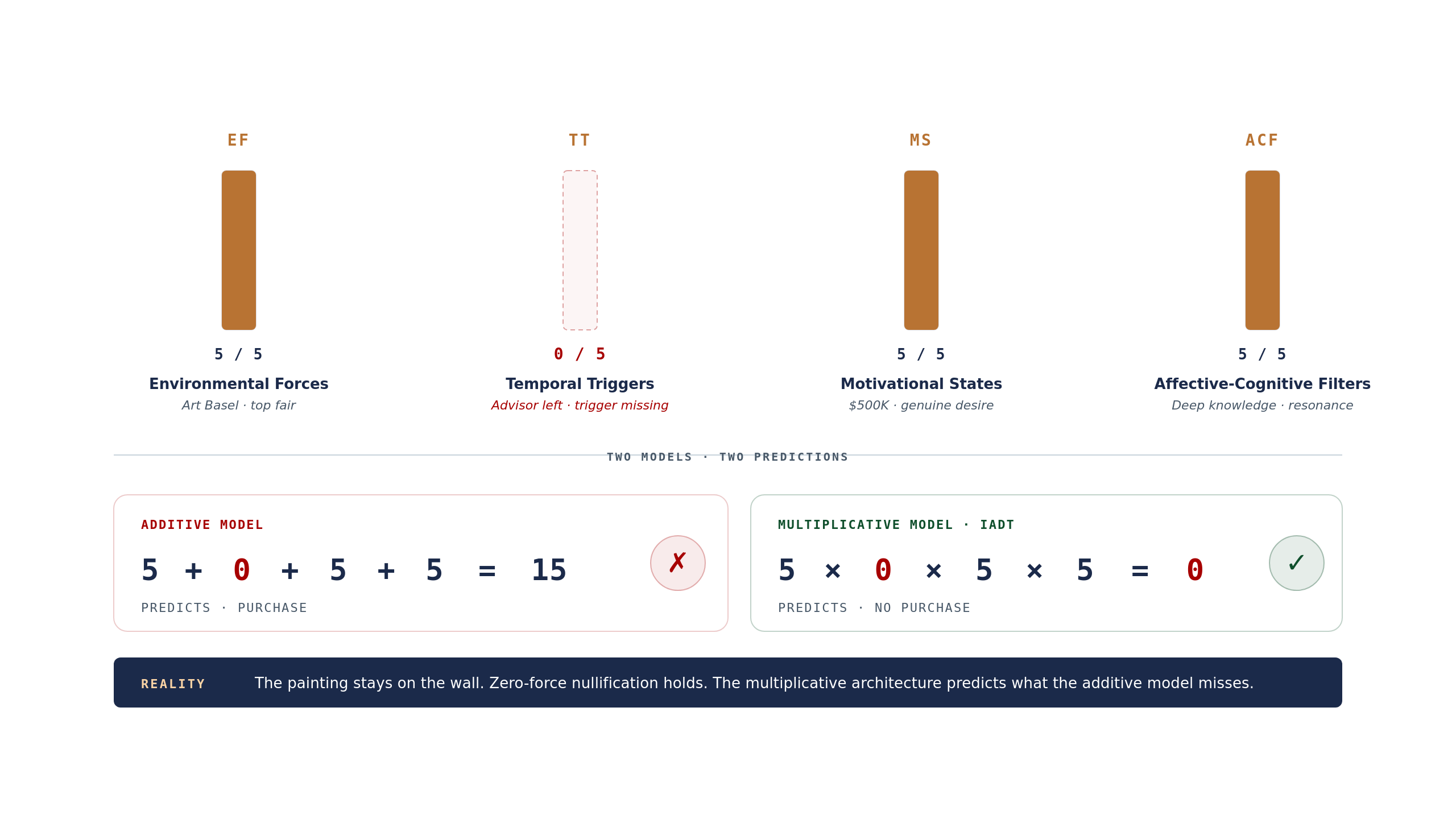
The forces inside the multiplication are environmental, temporal, motivational, and affective-cognitive. Each acts at its own scale and over its own time horizon. The four cards below show each force in turn, the substrates it operates across, and what fails when it goes to zero.
Macro conditions that reshape the decision environment.
Economic regimes, technological change, regulatory shifts, demographic trends, social movements, ecological pressures, and institutional transformations. The PESTEL frame describes these as external context. The IADT treats them as active drivers that create new needs, make existing assumptions obsolete, and alter the emotional and cognitive conditions in which decisions are made. A rising inflation environment is not background. It activates loss aversion, compresses time horizons, and changes how the other three forces interact.
When this force → 0
The operating environment becomes unviable. The Boeing 737 MAX certification ran a process whose environmental force, independent oversight, had been hollowed out. Engineering capability stayed high. Three hundred and forty-six lives were the index of the missing factor.
Datable events that open the windows in which action is possible.
Time-specific events, disruptions, or state-changes that create windows of heightened receptivity and demand response. Crises, announcements, personal milestones, institutional deadlines, encounters. The trigger's effect depends entirely on the configuration of the other three forces. The same announcement produces different actions in different people because the trigger interacts differently with their environmental awareness, motivational states, and affective-cognitive filters.
When this force → 0
The window closes before the agent acts. COVID-19 lockdown timing, March 2020. The epidemiological evidence was strong, the political mandate present, the functional need clear. The temporal trigger response, the days lost between evidence and decision, brought the actionable factor toward zero. The cascade ran ahead of the decision.
The dynamic hierarchy from functional need to identity aspiration.
Drawing on Maslow's hierarchy and its refinements, on Deci and Ryan on intrinsic versus extrinsic motivation, on Locke and Latham on goal-setting, and on Gutman's means-end chain linking attributes to values. The IADT treats motivational states as dynamic configurations that shift with environmental forces and temporal triggers. The critical distinction is between needs that demand solutions and desires that demand inspiration. They require different responses and interact differently with the other three forces.
When this force → 0
The motivational state is misspecified. The action is technically successful and actually wrong. A salesperson incentivised on volume rather than customer fit. A recommendation engine optimising for engagement rather than wellbeing. The structural form is identical across substrates.
The conversion mechanism that turns capability and intent into action.
Covering Kahneman and Tversky's documented biases, Damasio's somatic marker hypothesis, the dual-process framework, and Cialdini's influence principles. Affective-cognitive filters are not supplementary considerations. They are primary determinants of whether information leads to action or paralysis. Their effect is modulated by the configuration of the other three forces. Loss aversion in a stable environment is a manageable bias. Loss aversion under regime change becomes the binding constraint.
When this force → 0
The conversion mechanism collapses. The 2008 financial crisis: counterparty trust filter at zero, lending stopped completely. Capital was abundant, regulation in place, motivation to transact acute. The filter that converts available capital into actual lending is what failed. The other three forces could not compensate.
Domain-invariant · Biological · Artificial · Hybrid
For eighty years, decision science assumed the answer was addition. More motivation plus more capability plus more context equals more action. No one tested whether that assumption was correct. IADT did. The four forces that actually produce action were not named, their interaction was not specified, and neither had been validated across domains. The twelve advantages below are not improvements to existing frameworks. They are what follows when the foundational assumption changes.
Simon demonstrated in 1955 that rational choice theory fails descriptively. In the seven decades since, no theory has proposed a cross-disciplinary replacement. Lewin identified the need for a person-environment interaction model in 1936. Bandura elaborated the principle in 1986. Neither delivered the decomposed, formalised, testable version. IADT, arriving independently from practitioner application rather than the academic tradition, addresses the gap that the behavioural sciences had left open for nearly ninety years.
Every prior framework that identified relevant forces treated them as additive. Identifying important variables while leaving their interaction unspecified is not a minor limitation. It is a structural misspecification. IADT proposes that the interaction of four forces is the primary mechanism of action production, not a second-order correction to an otherwise adequate additive model. The main effects of individual pillars are less informative than their interactions. That claim is directly testable, and it has been tested.
The multiplicative specification entails a specific and consequential prediction that additive models cannot generate. If any one of the four forces is at zero, the outcome collapses regardless of the strength of the other three. A highly motivated actor with a clear temporal trigger and a favourable environment will not act if an affective-cognitive filter, such as paralysing fear or complete cognitive overload, reduces one force to zero. This zero-force condition is not an assumption. It is a derived consequence of the multiplicative form, and it generates predictions that no additive model can match.
IADT sits at the micro level of an integrated three-law structure. UCT specifies what aggregate behaviour follows when IADT configurations interact across a population. ISP specifies when analogies across domains are structurally valid. Researchers adopting IADT enter a complete framework. IADT specifies what each actor does. UCT specifies what population-level cascades follow. ISP specifies when findings from one domain transfer to another. The three laws extend each other's empirical reach.
The core empirical challenge that motivated IADT is the persistent failure of attribute-based models to explain why individuals with identical profiles make different decisions. IADT predicts this divergence. Two actors with the same demographic profile, the same risk tolerance, and the same stated preferences will make different decisions when their action-driver configurations differ. The prediction is specific: the configuration of four interacting forces determines the action, not the attributes of the actor.
Most decision frameworks are qualitative by design. IADT is not. The multiplicative equation and the pillar interaction structure give researchers a model that can be fitted to data, tested against additive alternatives, and used to construct quantitative predictions. The P3 × P4 interaction term is a specific, testable, and falsifiable claim. The delta-AIC, the f², and the cross-validated R² improvement are not retrospective summaries. They are the output of a pre-specified theoretical claim applied to independent data.
IADT identifies where in the configuration an intervention would have the greatest effect. An actor whose outcome is constrained by a near-zero affective-cognitive filter requires a different intervention from one whose temporal trigger has not yet fired. An actor whose motivational state is strong but whose perceived capability is low needs a different response from one whose environment is suppressing action. IADT maps the diagnosis to the pillar, before the intervention is designed.
The same four forces hold whether the decision-maker is a human actor, an AI agent, or a hybrid human-AI team. The content of each force differs by substrate. The interaction structure does not. IADT findings from one substrate transfer to another wherever the ISP criterion is satisfied. Researchers working across biological, artificial, and hybrid contexts do not need a different framework for each.
IADT specifies what would disprove it. Find a domain where an additive model consistently outperforms the multiplicative specification across independent datasets. Find an actor who acts despite one force being at zero. Find a domain where the P3 × P4 interaction does not rank among the strongest two-way interactions. Any of these outcomes would be an informative finding. The theory states its failure conditions in advance.
A systematic review of 37 existing frameworks across nine domains of decision science established that no prior theory integrates all four forces. Three independent validation studies then tested the multiplicative model against the best available additive alternatives. In every domain, the multiplicative specification won. The margin was not marginal. It replicated across two independent national samples in health behaviour. The civic participation data showed a turnout gradient that no additive model can generate. The results hold across civic, health, and financial decisions, in datasets the IADT did not design and cannot have been fitted to after the fact.
Four pillars. One interaction rule. A single equation generates the full specification. The 37 competing frameworks reviewed in the theory paper require separate models for separate domains. IADT applies the same equation across civic participation, health behaviour, financial decisions, art market selection, and institutional governance. Parsimony is not a stylistic preference. It is evidence that the framework is capturing structure rather than fitting noise.
The working paper is deposited on Zenodo with permanent DOI. Independent researchers can replicate every result, extend the empirical record, or attempt falsification using the published methodology. No institutional access required.
Nine domains of decision science, from rational choice and motivational psychology to institutional analysis and health behaviour, have produced thirty-seven frameworks for predicting human action. Each captured something real. Each made the same structural error: treating the determinants of action as independent forces that add up. None named the four forces that actually produce action. None specified their interaction. None tested that specification across domains. The entries below show a selection of the most important traditions, where each stops, and why IADT is the stronger framework.
von Neumann and Morgenstern (1944) · Simon (1955) · Kahneman and Tversky (1979)
Expected utility theory formalised the foundation of decision science: rational actors maximise expected utility based on stable, consistent preferences. Simon's bounded rationality established that cognitive limitations force actors to satisfice rather than optimise. Kahneman and Tversky documented systematic deviations from rationality and proposed Prospect Theory as the descriptive replacement. Together these three contributions define the dominant tradition in decision science for eighty years.
The formal architecture of choice under uncertainty. The mathematical precision that made modern decision science possible. The documented failure of the rational model in field conditions. The cognitive biases and heuristics that produce systematic deviation from expected utility predictions.
The additive assumption. Every framework in this tradition, including Prospect Theory, models determinants of action as independent contributors to an outcome. Attributes are measured, weighted, and summed. The interaction between forces is not specified as the primary mechanism. Simon identified what actors do not do. Kahneman and Tversky documented how and when they deviate. Neither proposed a positive theory of what actually produces action. That gap has persisted for seven decades.
IADT provides the positive theory that the rational choice tradition's own empirical program made necessary. The cognitive biases Kahneman and Tversky documented are incorporated into IADT's Affective-Cognitive Filters pillar. The bounded rationality Simon described is a consequence of force interaction, not a property of the actor. IADT does not challenge what this tradition got right. It specifies the interaction mechanism that no model in the tradition has supplied.
Lewin (1936, 1951)
Lewin proposed that behaviour is a function of the person and the environment, expressed as B = f(P, E), with person and environment constituting an interdependent life space. This was the earliest formulation of an interaction model in the behavioural sciences, and it identified the right principle nearly ninety years ago. An independently developed practitioner framework, the IADT, converging on the same foundational principle from a completely different starting point, strengthens the case that the principle is genuine.
The correct insight: that action is produced by the interaction of internal and external forces, not by either in isolation. The framework that every subsequent interaction model has either built on or independently rediscovered.
The principle was never decomposed, formalised, or tested. Lewin did not specify which components of the person interact with which components of the environment. His topological psychology used spatial metaphors rather than testable variable specifications. He did not distinguish temporal triggers from stable environmental conditions, or separate motivational states from cognitive-affective filters. The formula B = f(P, E) is directionally correct but empirically underspecified. Nearly ninety years after Lewin identified what was needed, the decomposed, specified, testable version had not been delivered.
IADT is the mathematical formalisation of what Lewin described in the abstract. The four pillars decompose P and E into specific, interacting forces. The multiplicative equation specifies the functional form. The empirical programme tests it across domains. Lewin pointed at the right structure. IADT builds it.
Bandura (1986, 1989)
Bandura proposed triadic reciprocal determinism: behaviour, personal factors (cognitive, affective, and biological), and environmental factors interact continuously. This is the closest existing theory to the IADT's interaction model and requires precise engagement. The IADT acknowledges Bandura's contribution as the most significant precursor. The relationship is one of extension, not replacement.
A genuine interaction model at the level of principle. The reciprocal relationship between personal factors, environment, and behaviour. Self-efficacy as a key determinant of action. The framework that moved decision science beyond the person-versus-environment debate by proposing that both interact.
Three specific gaps. First, Bandura's personal factors category is a composite. The IADT decomposes it into two distinct pillars: Motivational States and Affective-Cognitive Filters. The decomposition matters because motivation and cognitive filters can oppose each other, and modelling their interaction requires treating them as separate forces. Collapse them and the most consequential configurations, high motivation combined with low capability, or action despite weak motivation, become invisible. Second, temporal triggers are subsumed within the environment category. IADT proposes that triggers operate differently from stable environmental conditions and that their interaction with the other forces produces qualitatively different decision dynamics. Third, and most consequentially, Bandura's model is specified verbally and diagrammatically but not mathematically. It proposes interaction without specifying the functional form.
IADT supplies the mathematical specification that Social Cognitive Theory described in the abstract. Four pillars replace three composite categories. Temporal triggers are separated from stable environmental conditions. The multiplicative equation is testable, and the tests have been run. In three independent datasets, the interaction model outperforms the additive baseline that empirical applications of Social Cognitive Theory have defaulted to for four decades.
Ajzen (1991)
The Theory of Planned Behaviour predicts behavioural intention as a function of attitudes, subjective norms, and perceived behavioural control. It has been applied across hundreds of behavioural domains, reviewed in thousands of papers, and remains the most widely tested predictive model in social psychology. Its predictive validity is real but bounded: meta-analyses report that it accounts for approximately 19 to 27 percent of variance in behaviour, with a persistent intention-behaviour gap.
A structured, testable model that links attitudes, social norms, and perceived control to intention and behaviour. The most disciplined empirical program for testing multi-component predictors of action. The systematic documentation of its own limits, including the intention-behaviour gap, through decades of replication.
The additive specification. Attitudes, norms, and perceived control are treated as independent predictors that sum to intention. Their interaction is not the mechanism. Environmental forces and temporal triggers are not distinct constructs in the model. Decades of application have documented the gap between what the model predicts and what people actually do.
A single theoretically derived interaction term, added to the best available additive baseline, outperformed the full additive model in independent tests across two countries. The finding is not that the TPB is wrong. It is that the additive specification is a systematic misspecification. Motivation is nearly twice as effective when perceived capability is high than when it is low. An additive model cannot see that. The forces do not add. They multiply.
Ostrom (1990, 2005) · Bourdieu (1977, 1984)
Ostrom built the most important framework for understanding collective action in the past half-century. Her Institutional Analysis and Development framework explains when governance structures support sustainable collective outcomes and when they do not, through rules-in-use, community attributes, and the physical conditions of the resource. Bourdieu proposed that behaviour is shaped by habitus, the durable dispositions formed through social experience and mediated by economic, cultural, social, and symbolic capital.
The mechanisms of institutional structure and its effect on collective behaviour. How social position shapes individual dispositions over time. The empirical regularity that institutional patterns persist. The framework for diagnosing when collective action succeeds and when it fails.
Neither framework models the decision-making process of the individual within the institution. Ostrom's actors respond to rules and incentives. The psychological and emotional forces that determine whether a specific individual cooperates or defects, complies or deviates, are treated as inputs to the institutional model rather than as objects of analysis. Bourdieu's habitus is stable by design. It explains baseline tendencies, not specific decisions in specific moments. Neither framework specifies what drives the individual to act right now.
IADT provides the micro-foundation that institutional analysis requires. Institutions are composed of actors, and an actor is defined by the act of acting. Without the forces that drive individuals to act, institutional structures are empty. IADT models what Ostrom's framework treats as given: the dynamic forces that determine whether each individual, in each specific moment, cooperates or defects, participates or withholds. Bourdieu's habitus maps to the stable component of Motivational States and Affective-Cognitive Filters. IADT dynamises it by modelling how habitual dispositions interact with environmental forces and temporal triggers to produce action or suppress it.
The Integrated Action-Driver Theory (IADT) was tested across nine domains spanning biological and artificial agents. The Zero-Force Nullification signature was found in every domain examined. The multiplicative specification outperforms the additive consensus by a margin that is large at the centre of the distribution and decisive at the breaking points.
Across behavioural science, decision theory, organisational studies, and the philosophy of mind.
From financial cascades to public health to agentic AI behaviour.
Nine domains and twenty-one cases. Confirmed in every one.
Open replication. Paper deposited on Zenodo with permanent DOIs.
Most behavioural-science frameworks do not specify their own falsification conditions. The IADT does. The criterion is concrete, dated, and reproducible. A confirmed case marks a boundary, not an ending. The boundary is itself a finding, and the work continues from there.
If an actor or agent acts successfully when one of the four forces is at zero, the multiplicative specification is wrong for that domain. Either the model collapses to additive in that case, or the four-force decomposition was incomplete to begin with. Either outcome is informative.
The first law IADT governs how a single decision is made. Upward, it connects to the second law, the Unified Cascade Theory, which describes how those decisions aggregate into institutional outcomes. Outward, it connects to the third law, the Identical Scale Principle, which specifies when the same logic transfers across substrates and domains.

How individual decisions aggregate into institutional outcomes through three sequential phases. Ignition. Polarisation. Institutionalisation.

A criterion for when a structural pattern recurs across scales and domains. The pattern transfers only where structural identity holds.
Patrick Mehrhoff is a German entrepreneur, independent researcher, AI engineer, and author. He is the author of the three original theories that constitute the Mehrhoff Research Program. He built the work the studio carries.
Most practitioners spend a career inside one domain. He worked as a practitioner at six of the frontiers that redefined how society organises information, money, and value over the last two decades. The consumer internet, Swiss fintech, European monetary policy, Southeast Asian financial publishing, institutional crypto assets, and the first wave of applied AI.
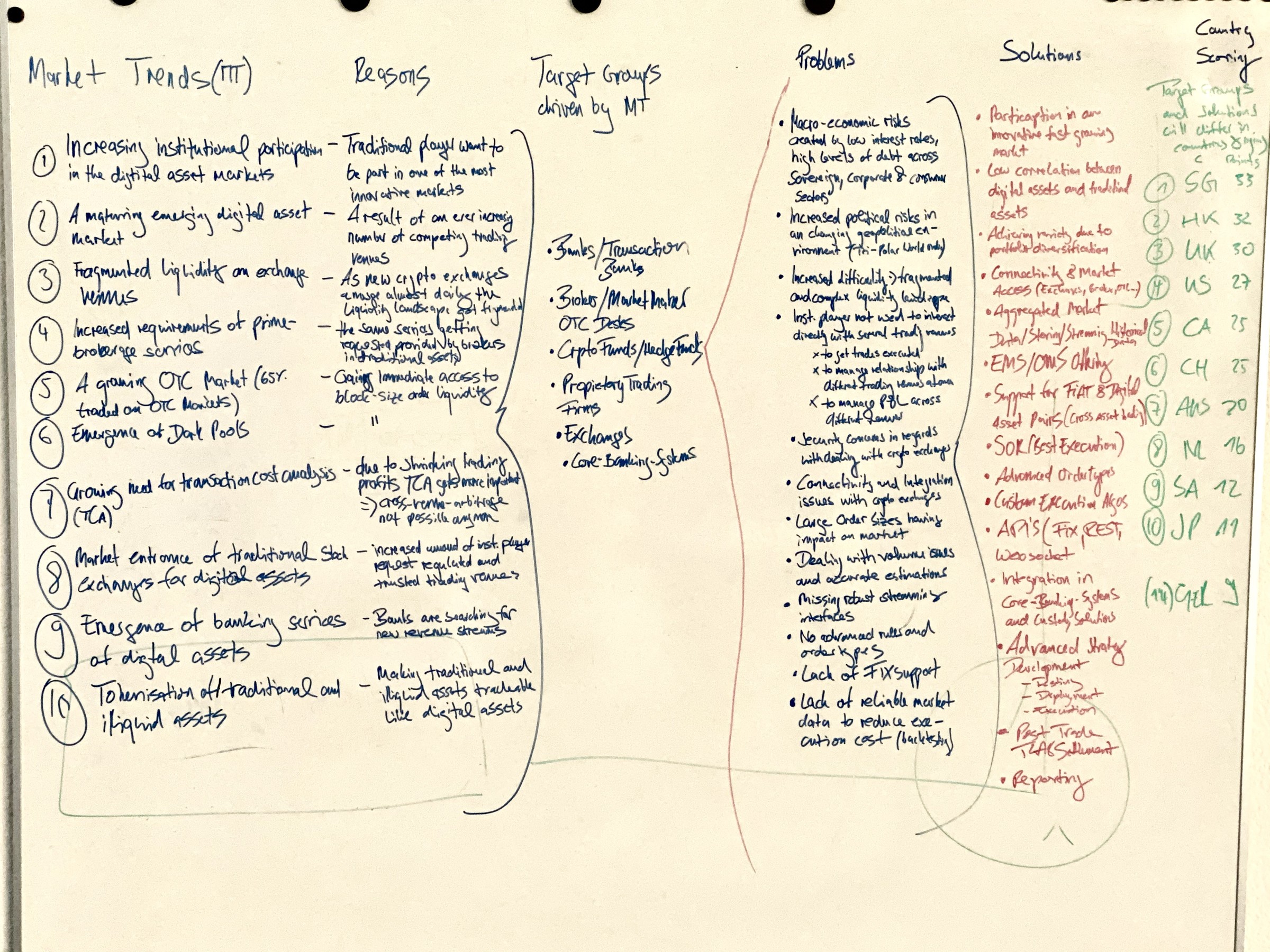
The same structural observation appeared at every frontier. By 2019, on a whiteboard at crypto infrastructure provider Wyden in Zurich, the pattern had become visible to itself. It did not yet have a name. Four years before any AI language model became publicly available, the complete logic of the Three Laws of Decision-Making was already on the whiteboard.
The studio was built from Bangkok, without institutional affiliation and without external funding. The Rubens workshop model defines how it operates. The founder sets the intellectual direction at every decisive step. The tools and collaborators execute within it.

Tested against nine foundational scholars, three of them Nobel laureates, and across fifteen structural dimensions. Every cell is independently challengeable.
Every dimension independently challengeable.
Most frequently cited as predecessors.
Among the nine scholars tested.
Confirmed across all nine scholars.

The three laws describe the same multiplicative structure that governs decisions across scales. What each audience recognises in them is different. Each doorway below opens into the same set of laws, framed for the way you are most likely to find your own work inside them.

The literature in your field has been reporting tail-failure for decades. Outliers, noise, model misspecification. The three laws name a different culprit. The structural form of the model itself. Read the laws and find the place where the assumption you never questioned has been doing the work all along.

Every senior decision-maker has watched a model work on average and break where the decision mattered. The three laws name what is happening. The breakage is not an edge case the model failed to anticipate. It is the multiplicative architecture finding its zero. Read the laws and the pattern beneath every model break of your career becomes legible at once.

Each major institutional cascade of the past fifteen years was investigated as if it were unique. The reports document different operational failures in different sectors. The three laws read across the reports and recognise one structural pattern. Read the laws and the recurrence stops looking like coincidence.

Every philosophical tradition that has tried to describe the world has eventually arrived at the same conclusion. The three laws turn the conclusion into a working structural explanation. Decisions form. They cascade. Their patterns transfer across scales. Read the laws the way our studio reads them.
Most foundational research is finished before a student arrives. The three laws sit early enough in their life that the field around them is still to being created. A graduate student who reads them now enters a body of work inside its formative window. The reading path is curated for entry from any quantitative or social-science background.

Universities train within additive frameworks. Journals review within them. Regulators write rules under them. Funders evaluate against them. The three laws name the structural assumption beneath the entire foundational layer. It has been invisible because no curriculum, no review, no framework has ever required it to be examined. Read the corpus and the link your institution has been operating without becomes legible.
The first program states the architecture and demonstrates the laws that govern it. The second tests those laws against the empirical record of human decision-making. Together they establish the studio's canonical core and its first empirical substantiation. Further programs are in active preparation.
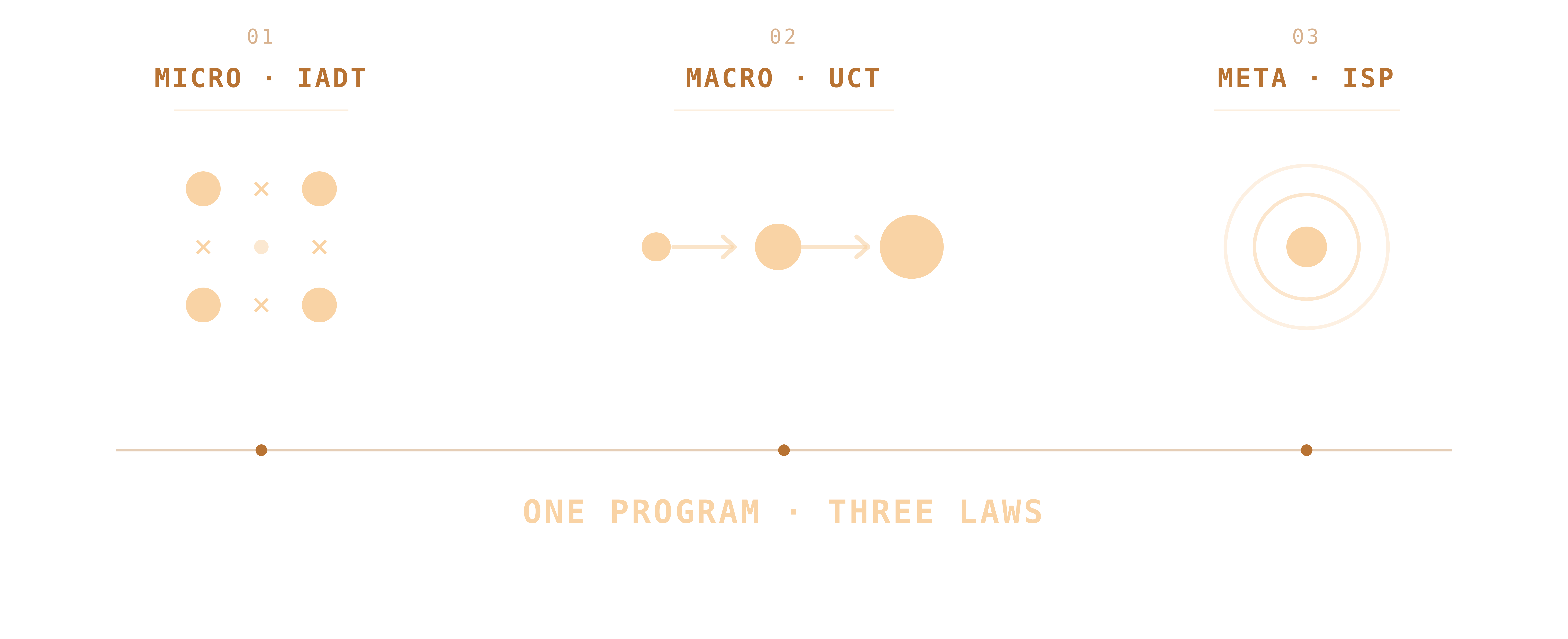
The three laws at the micro, macro, and meta scales, derived and stated formally. Plus the empirical evidence that the multiplicative architecture holds across biological, artificial, and hybrid substrates. Every paper in every other program traces its structural claims back to this canonical core.
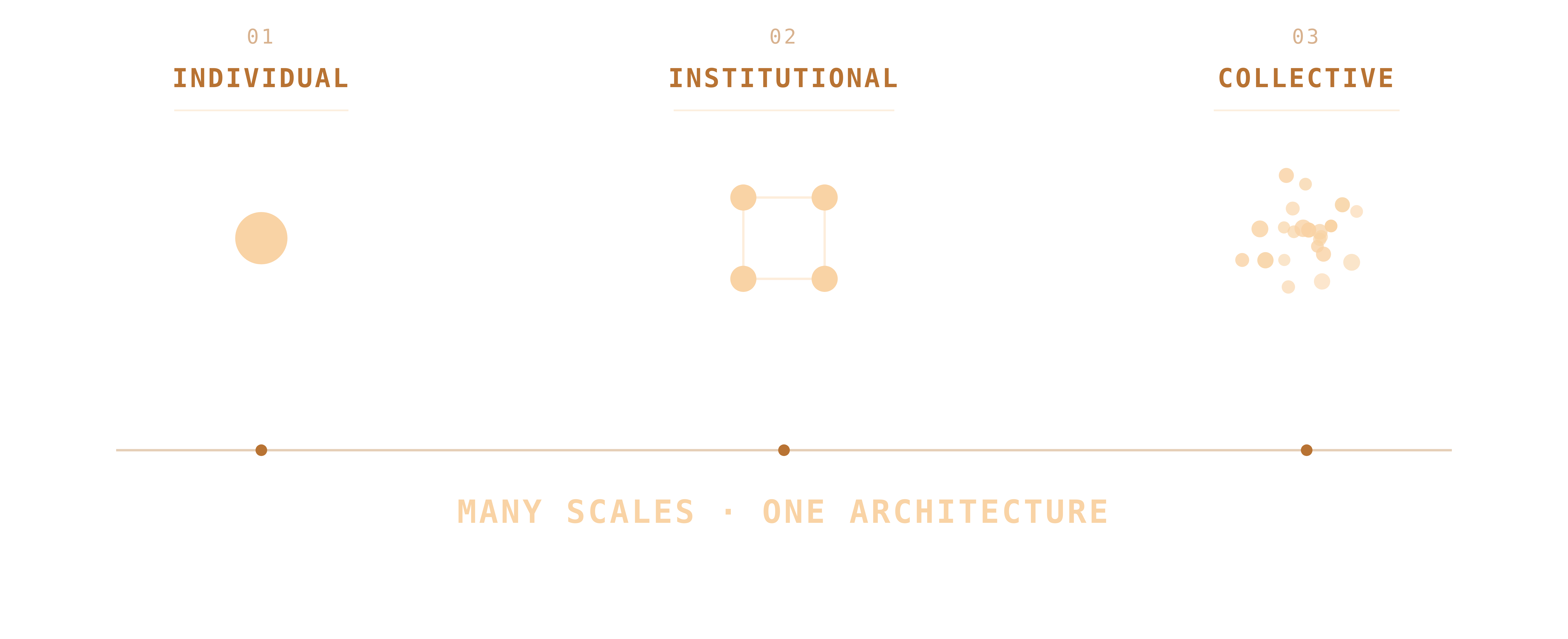
The laws tested against the empirical record from every sector, industry, and discipline where humans make decisions. From financial risk to clinical judgement to educational selection to electoral behaviour, the same multiplicative architecture governs the outcome. Every test in the program substantiates the structural finding the foundational program advanced.
The first sketch of the Three Universal Laws. Drawn four years before any AI language model became publicly available.
Sketched at an office in Zurich. The board maps the direction of the markets, the forces driving them, the audiences they affected, the problems those audiences encountered, and the responses the market was developing. The structural logic that became the First, Second, and Third Laws is already on the board, in the language of practice.
Mehrhoff Research operates outside academia and outside industry. An independent science and research studio with no external funding, no board, and no university partnership. Founded 2019 in Zurich, domiciled in Tallinn, run from Bangkok.
The work is published open access. Every paper passes adversarial peer review before deposit. Every claim names the empirical conditions under which it would be falsified. Every citation traces to a primary source. The standard is not the institution. The standard is the work.
Deposited on Zenodo, permanently archived.
Data points analysed across all empirical validations.
Foundational and human decision-making.
No paywall, no journal embargo.

A horizon decades away. The daily practice of moving toward it. Seven principles the studio holds itself to, with or without anyone looking. Five codes the studio answers to when no external authority requires them. Each statement enforced internally. Each verifiable from outside.

Vision and mission, stated directly. What the studio is working toward, and what it does today.

Seven standards held against every paper, every conversation, every relationship the studio enters. Decision-making, rigour, independence, transparency, originality, curiosity, and courage.

Self-regulated science. Published standards, open methods, full results regardless of what they show.
Press, academic peers, conference organisers, policy bodies, industry practitioners, and readers reach the studio here.
Six formats, from public keynote to closed doctoral seminar. The full range is welcome; the substance of the questions decides the invitation.
Four positions, from visiting researcher to fellowship, with two scheduled per calendar year. A residency produces sharper work than a single talk because the conversation extends.
Press kit with bios, headshots, and topic briefs is ready to download. Lectures, learning materials, and the architecture itself are licensable.