
Every analogy in science teaching is treated as imperfect by design. Every framework for analogy instruction builds in a step to identify where it breaks down. The Identical Scale Principle challenges that assumption. When source and target are governed by the same law at different scales, and the learner has direct sensory experience of the source, the analogy has zero shortcomings. Not fewer shortcomings. Zero. The ISP is the test.

The principle is applied to four common analogies. Two pass, two fail. The verdicts are concrete, repeatable, and dated. When the principle fails an analogy, it names the criterion that broke and tells the researcher exactly where the structural identity collapsed.
STRUCTURAL MATCH · 8 of 10 structural properties match
Eight of ten structural properties match. Bijective mapping holds. Power-law return distributions appear in both markets. The analogy passes all three criteria, including domain invariance across art and finance. Knowledge transferred from financial-market microstructure produces empirically correct predictions in the art market.
STRUCTURAL MATCH · Governing Law · Hooke’s Law · linear elastic regime
The same physical law applies to source and target. The scale difference is three orders of magnitude. Structural identity holds. Scale independence holds. Direct sensory experience of the rubber band is near-universal. A zero-shortcoming pedagogical analogy. Twenty other cases across the secondary science curriculum follow the same pattern.
NO STRUCTURAL MATCH · No bijective mapping
No one-to-one correspondence exists between neural and computational components. Synaptic plasticity does not map onto fixed-architecture computation. The analogy is suggestive in the popular register and structurally invalid as a basis for cross-domain knowledge transfer. Structural identity fails before scale independence is even tested.
NO STRUCTURAL MATCH · Causal relations not preserved
The mapping looks neat. The causal structure does not survive scrutiny. Mechanical efficiency assumes deterministic input-output coupling. Market efficiency depends on participant beliefs, which feed back into prices, which change beliefs. The analogy fails on the causal-preservation requirement.
When the principle fails an analogy, the failure is the finding. The researcher learns exactly which criterion broke.
The Identical Scale Principle works through three criteria. Two establish whether a pattern holds across scales. A third determines whether it holds across disciplines. All three are operational: any researcher can apply them to any candidate analogy using published literature alone. When all three pass, the transfer is not approximate. It is exact.
Dip a paper towel into a glass and the water climbs ten centimetres up the cellulose fibres. The same law moves water a hundred metres up a redwood, from root to leaf, against gravity, without a pump. The fibres in the towel and the channels in the tree are governed by the same equation at different scales. Structural identity holds. Scale independence holds. The law crosses from kitchen physics into plant biology without changing form. The kitchen experience is not a metaphor for the science. It is the science.

The three criteria are sequential and non-interchangeable. Each addresses a different dimension of structural transfer. Structural Identity is the strongest test and the one most analogies fail. Scale Independence is what distinguishes a genuine structural pattern from a scale-dependent observation. Domain Invariance is what extends the principle from natural science into any domain governed by deterministic causal law.
A bijective mapping that preserves all causal relations between source and target.
Every component of the source has a unique counterpart in the target. Every causal arrow in the source has a counterpart arrow in the target, with the same direction and the same role. The mapping function can be written down, not gestured at. This is the strongest of the three criteria, and the one most analogies fail. Hesse’s analogy theory and Gentner’s structure-mapping theory each pointed toward this condition without specifying it formally. The Identical Scale Principle specifies it.
When this criterion fails
“The brain is a computer” fails here. Neurones do not map one-to-one onto transistors. Synaptic plasticity does not map onto fixed-architecture computation. The analogy is suggestive in the popular register and structurally invalid as a basis for cross-domain knowledge transfer.
The structural identity holds across orders of magnitude.
A pattern that holds at one scale but breaks at another is scale-confined, not universal. The Identical Scale Principle requires the mapping to survive a change of scale. Allometric scaling laws govern metabolism in a mouse and an elephant. Hooke’s Law governs a stretched rubber band and a tensioned bridge cable. When the criterion holds, the mapping is genuinely about the structure, not the implementation. When it fails, the analogy was confined to one regime.
When this criterion fails
A behavioural pattern that holds in a laboratory but breaks at population scale was never universal. It was a local regularity. Cross-domain transfer built on it fails in deployment.
The structural identity holds across disciplinary boundaries.
A pattern that holds within one discipline but breaks at the boundary of another is domain-dependent. The Identical Scale Principle requires the mapping to cross disciplines without reformulation. Power-law return distributions appear in financial markets, in art markets, and in earthquake magnitudes. The same mathematical structure governs each. The Determinism Criterion gives the formal refinement that operationalises this condition outside natural science. Statistical regularities and qualitative tendencies do not qualify, regardless of how reliable they appear. Deterministic mathematical laws do, regardless of the discipline they came from.
When this criterion fails
A regularity that does not survive translation into another discipline was never cross-domain. It was domain-specific, described in universal-sounding language. The Pareto distribution and supply-and-demand are the most common cases. Both look universal. Neither is governed by a deterministic law. Claims built on them do not transfer.
Domain-invariant · Biological · Artificial · Hybrid
For 2,400 years, analogy theory treated shortcomings as inevitable. Every framework from Glynn’s Teaching With Analogies model to Harrison and Coll’s FAR Guide to Niebert’s embodied analogy research built in a step to identify where each analogy breaks down. That assumption was never tested as a general claim. The Identical Scale Principle tests it. The twelve advantages below are not improvements to existing frameworks. They are what follows when the foundational assumption changes.
Aristotle identified the problem of analogy. Mill made it logical. Hesse made it epistemological. Gentner made it cognitive. None specified the conditions under which shortcomings are not merely minimised but structurally eliminated. ISP, arriving independently from practitioner application in 2018, provides the falsifiable test that twenty-four centuries of analogy theory did not deliver.
Prior frameworks advised teachers to minimise shortcomings and communicate them explicitly. ISP specifies the two conditions under which shortcomings are eliminated entirely. The shift from advice to criterion is the contribution. A criterion can be applied, tested, and falsified. Advice cannot.
The extension of ISP beyond natural science required a formal boundary condition. ISP derives it from first principles: only relationships governed by deterministic causal laws qualify. Statistical regularities describe aggregate tendencies, not governing equations. They fail the criterion. Deterministic mathematical laws pass it, regardless of which discipline they came from.
ISP sits at the meta level of an integrated three-law structure. IADT specifies what each actor decides. UCT specifies how those decisions aggregate into institutional cascades. ISP specifies when the structural patterns of both transfer across domains. The three laws extend each other’s empirical reach.
ISP generates specific, falsifiable predictions about which analogies will produce misconceptions and which will not, before the teaching occurs. The seismology case independently confirmed ISP’s prediction: water waves and seismic body waves are governed by different equations, and shortcomings were documented by seismology educators before and independently of the ISP framework.
Most decision frameworks are qualitative by design. IADT is not. The multiplicative equation and the pillar interaction structure give researchers a model that can be fitted to data, tested against additive alternatives, and used to construct quantitative predictions. The P3 × P4 interaction term is a specific, testable, and falsifiable claim. The delta-AIC, the f², and the cross-validated R² improvement are not retrospective summaries. They are the output of a pre-specified theoretical claim applied to independent data.
ISP maps the secondary science curriculum to identify where zero-shortcoming analogies exist and where they do not. Twenty-one confirmed cases across eight domains. The methodology is published and replicable. Curriculum developers can apply it proactively during unit design rather than retroactively as a quality check.
The Determinism Criterion extends ISP beyond natural science. Three cross-domain cases have been confirmed. The criterion correctly rejected the analogies most researchers assumed were universal. The ones that passed produced accurate predictions in their target domains.
ISP specifies what would disprove it: find a mapping that passes all three criteria yet produces systematically wrong predictions in the target domain. Either outcome is informative. The principle states its failure conditions in advance. Most analogy frameworks do not state what would constitute failure. ISP does.
Twenty-one confirmed cases across the secondary science curriculum. Three cross-domain extensions confirmed beyond natural science. Eight of ten structural properties match between art and financial markets. The correlation is 0.967. The seismology case confirmed ISP's prediction using evidence that predates the framework.
Three criteria. Each addresses one dimension of structural transfer. Together they generate the full specification of when an analogy is zero-shortcoming, when it has shortcomings, and which criterion caused the failure. The existing literature requires multiple separate frameworks to describe what ISP derives from three jointly sufficient conditions.
The working paper is deposited on Zenodo with permanent DOI. Independent researchers can replicate every result, extend the empirical record, or attempt falsification using the published methodology. No institutional access required.
Aristotle identified the question in 350 BCE. Four schools refined it. None delivered a falsifiable test. ISP did, arriving independently from practitioner application in 2018 without reference to any predecessor. The convergence is not a coincidence. It is confirmation that the underlying structure is real.
Aristotle (~350 BCE)
Aristotle made analogy a tool of argument. He identified that productive analogies preserve structural relations between domains rather than surface features. This was the founding insight and it anchored the study of analogy for two millennia.
The first systematic account of analogical reasoning. The recognition that relation-preservation, not object-similarity, is what makes analogies work. The framework that every subsequent theory has had to engage.
Aristotle treated analogy as a rhetorical and logical device. He did not specify conditions for when analogical transfer preserves truth. The question of what makes one analogy epistemically valid and another misleading was left open.
ISP provides the falsifiable test that Aristotle’s framework did not require. Structural Identity operationalises “preserving relations” as bijective causal mapping. Scale Independence and Domain Invariance specify when that preservation survives a change of scale or disciplinary context. The rhetorical insight becomes a scientific criterion.
John Stuart Mill (1843)
Mill formalised analogy as a mode of inductive inference, placing it within a systematic logic of scientific reasoning. He recognised that analogical strength depends on the causal relevance of the known similarities, not their number.
The first principled account of analogical inference as a logical procedure. The recognition that causal relevance, not merely similarity, is what gives analogies evidential weight. The connection between analogy and the broader methods of scientific reasoning.
Mill’s framework treated analogical strength as a matter of degree and probability. He did not specify when an analogy is zero-shortcoming only when it is more or less likely to hold. The criterion for structural elimination of shortcomings was not proposed.
ISP replaces probabilistic assessment with a structural criterion. Structural Identity specifies the bijective mapping that makes an analogy structurally true rather than merely probable. The shift from probability to structural necessity is what allows ISP to predict zero shortcomings rather than fewer.
Mary Hesse (1966)
Hesse distinguished formal analogy from material analogy and argued that productive analogies require a causal condition and a no-essential-difference condition. Her framework established that good analogies are epistemically consequential, not merely pedagogically convenient.
The correct desiderata. Causal grounding. Absence of essential differences. A philosophical framework that took analogy seriously as an epistemological tool rather than a rhetorical one. The closest prior account to the ISP’s structural conditions.
Hesse’s conditions remained difficult to operationalise. The criteria for “essential difference” were not formally specified. The framework identified what was needed without delivering the test.
ISP operationalises Hesse’s conditions. Nomological identity replaces “causal grounding” with a specific, checkable requirement. The Determinism Criterion replaces “absence of essential differences” with a formal test that any researcher can apply.
Dedre Gentner (1983)
Gentner proposed that analogy operates by mapping relational structures rather than object attributes, and that productive analogies systematically preserve higher-order relations. Structure-mapping theory remains the dominant computational account of analogical reasoning.
The computational mechanism of analogical reasoning. The systematicity principle that higher-order relational structure is what makes analogies feel illuminating. The most influential formal theory of analogy in cognitive science.
Gentner’s framework explained the cognitive process of drawing analogies but did not distinguish epistemically valid analogies from epistemically misleading ones. A mapping can be highly systematic in Gentner’s sense and still produce misconceptions when the governing laws diverge.
ISP adds the nomological condition that structure-mapping theory does not specify. Structural Identity requires not merely that relations are preserved but that the causal law producing those relations is identical in both domains. The cognitive account becomes an epistemic criterion.
The Identical Scale Principle has been applied across the secondary science and mathematics curriculum, across financial mathematics, and across the boundary between physical science and the social sciences. The principle predicts which analogies should pass and which should fail before the empirical work is done. The predictions hold.
Across physics, chemistry, biology, mathematics, and Earth science. Catalogued in the secondary curriculum paper.
Physics, chemistry, biology, Earth science, and mathematics. All eight subdomain areas of the secondary curriculum confirmed.
Financial mathematics, visual art, and music. Three confirmed cases beyond natural science, validating C3 through the Determinism Criterion.
Aristotle, Mill, Hesse, Gentner, Mehrhoff. Each generation refined the question. Only Mehrhoff specifies the solution and falsifiable test.
The ISP criterion is concrete, dated, and reproducible. A confirmed case that meets the conditions and survives independent review is a boundary finding. The boundary is itself a contribution. Most behavioural-science frameworks do not specify their own failure conditions. A confirmed case establishes a boundary, not an ending. The principle survives until a counter-case is documented and replicated.
If such a case exists, structural identity, scale independence, and domain invariance are necessary but not sufficient. The principle would still operate as a filter that rules out invalid analogies, but it would no longer guarantee transfer success. Either outcome is informative. The principle survives until a counter-case is documented and replicated.
The third law ISP governs when a structural pattern transfers across scales and domains. Outward from IADT, it specifies when the individual decision architecture transfers across biological, artificial, and hybrid actors. Outward from UCT, it specifies when the cascade dynamics transfer across substrates and domains. ISP does not sit above the other two laws. It sits beside them, as the criterion that makes their cross-domain claims defensible.

Action under complexity is determined by the dynamic interaction of four forces. The interaction itself is the mechanism. Additive models systematically under-perform because they cannot represent it.

How individual decisions aggregate into institutional outcomes through three sequential phases. Ignition. Polarisation. Institutionalisation.
Patrick Mehrhoff is a German entrepreneur, independent researcher, AI engineer, and author. He is the author of the three original theories that constitute the Mehrhoff Research Program. He built the work the studio carries.
Most practitioners spend a career inside one domain. He worked as a practitioner at six of the frontiers that redefined how society organises information, money, and value over the last two decades. The consumer internet, Swiss fintech, European monetary policy, Southeast Asian financial publishing, institutional crypto assets, and the first wave of applied AI.
The same structural observation appeared at every frontier. By 2019, on a whiteboard at crypto infrastructure provider Wyden in Zurich, the pattern had become visible to itself. It did not yet have a name. Four years before any AI language model became publicly available, the complete logic of the Three Laws of Decision-Making was already on the whiteboard.
The studio was built from Bangkok, without institutional affiliation and without external funding. The Rubens workshop model defines how it operates. The founder sets the intellectual direction at every decisive step. The tools and collaborators execute within it.

Tested against nine foundational scholars, three of them Nobel laureates, and across fifteen structural dimensions. Every cell is independently challengeable.
Every dimension independently challengeable.
Most frequently cited as predecessors.
Among the nine scholars tested.
Confirmed across all nine scholars.

The three laws describe the same multiplicative structure that governs decisions across scales. What each audience recognises in them is different. Each doorway below opens into the same set of laws, framed for the way you are most likely to find your own work inside them.

The literature in your field has been reporting tail-failure for decades. Outliers, noise, model misspecification. The three laws name a different culprit. The structural form of the model itself. Read the laws and find the place where the assumption you never questioned has been doing the work all along.

Every senior decision-maker has watched a model work on average and break where the decision mattered. The three laws name what is happening. The breakage is not an edge case the model failed to anticipate. It is the multiplicative architecture finding its zero. Read the laws and the pattern beneath every model break of your career becomes legible at once.

Each major institutional cascade of the past fifteen years was investigated as if it were unique. The reports document different operational failures in different sectors. The three laws read across the reports and recognise one structural pattern. Read the laws and the recurrence stops looking like coincidence.

Every philosophical tradition that has tried to describe the world has eventually arrived at the same conclusion. The three laws turn the conclusion into a working structural explanation. Decisions form. They cascade. Their patterns transfer across scales. Read the laws the way our studio reads them.
Most foundational research is finished before a student arrives. The three laws sit early enough in their life that the field around them is still to being created. A graduate student who reads them now enters a body of work inside its formative window. The reading path is curated for entry from any quantitative or social-science background.

Universities train within additive frameworks. Journals review within them. Regulators write rules under them. Funders evaluate against them. The three laws name the structural assumption beneath the entire foundational layer. It has been invisible because no curriculum, no review, no framework has ever required it to be examined. Read the corpus and the link your institution has been operating without becomes legible.
The first program states the architecture and demonstrates the laws that govern it. The second tests those laws against the empirical record of human decision-making. Together they establish the studio's canonical core and its first empirical substantiation. Further programs are in active preparation.
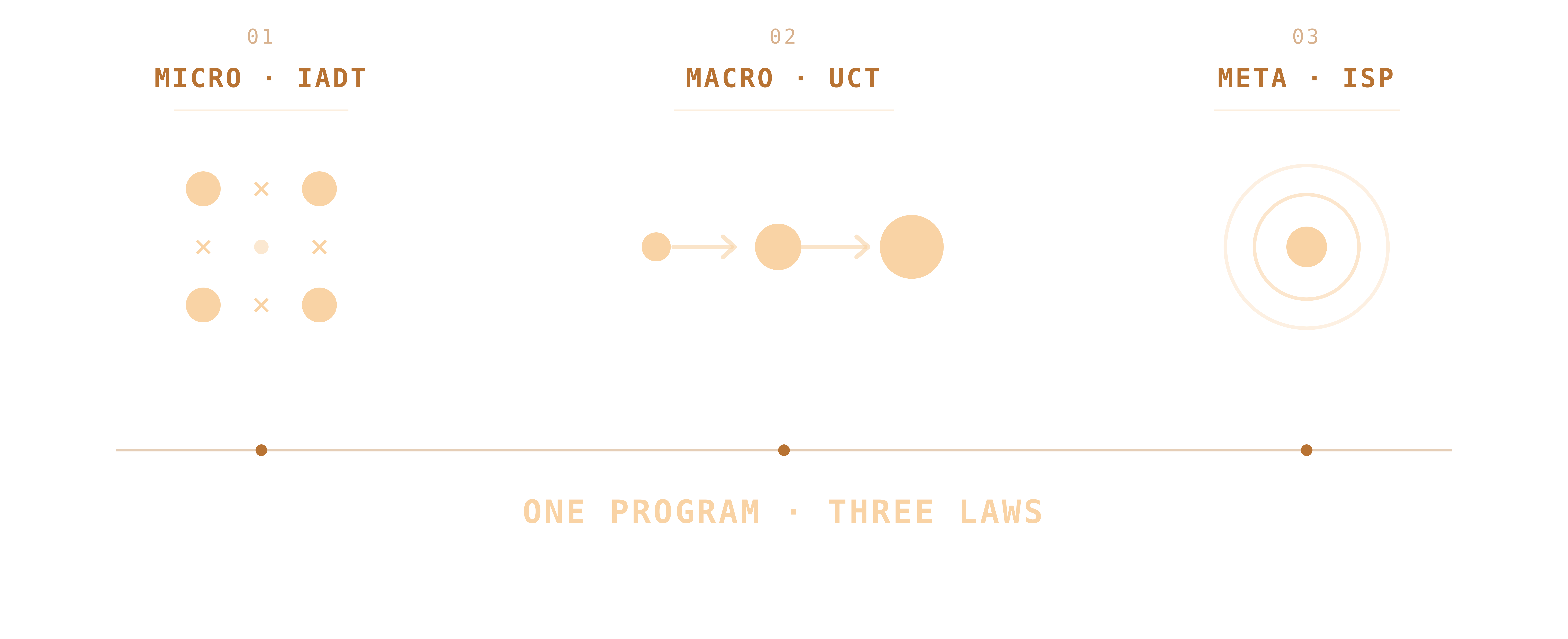
The three laws at the micro, macro, and meta scales, derived and stated formally. Plus the empirical evidence that the multiplicative architecture holds across biological, artificial, and hybrid substrates. Every paper in every other program traces its structural claims back to this canonical core.
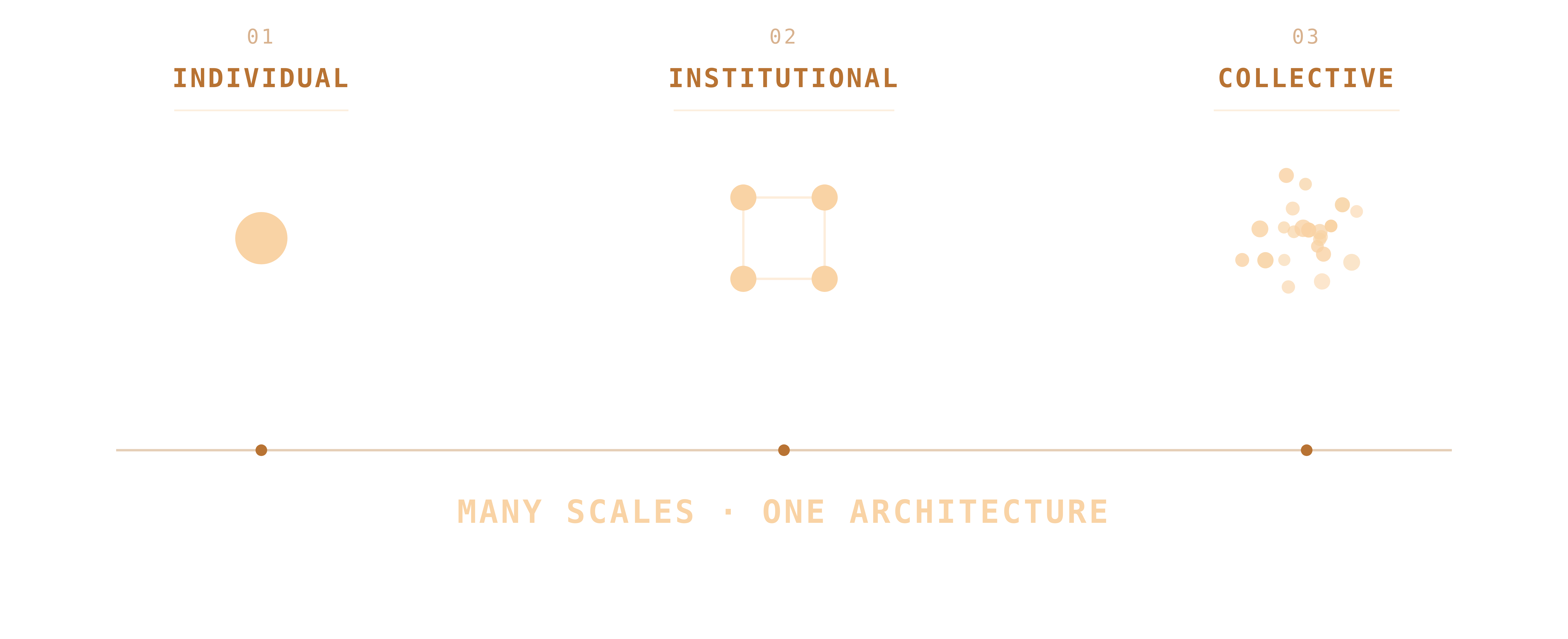
The laws tested against the empirical record from every sector, industry, and discipline where humans make decisions. From financial risk to clinical judgement to educational selection to electoral behaviour, the same multiplicative architecture governs the outcome. Every test in the program substantiates the structural finding the foundational program advanced.
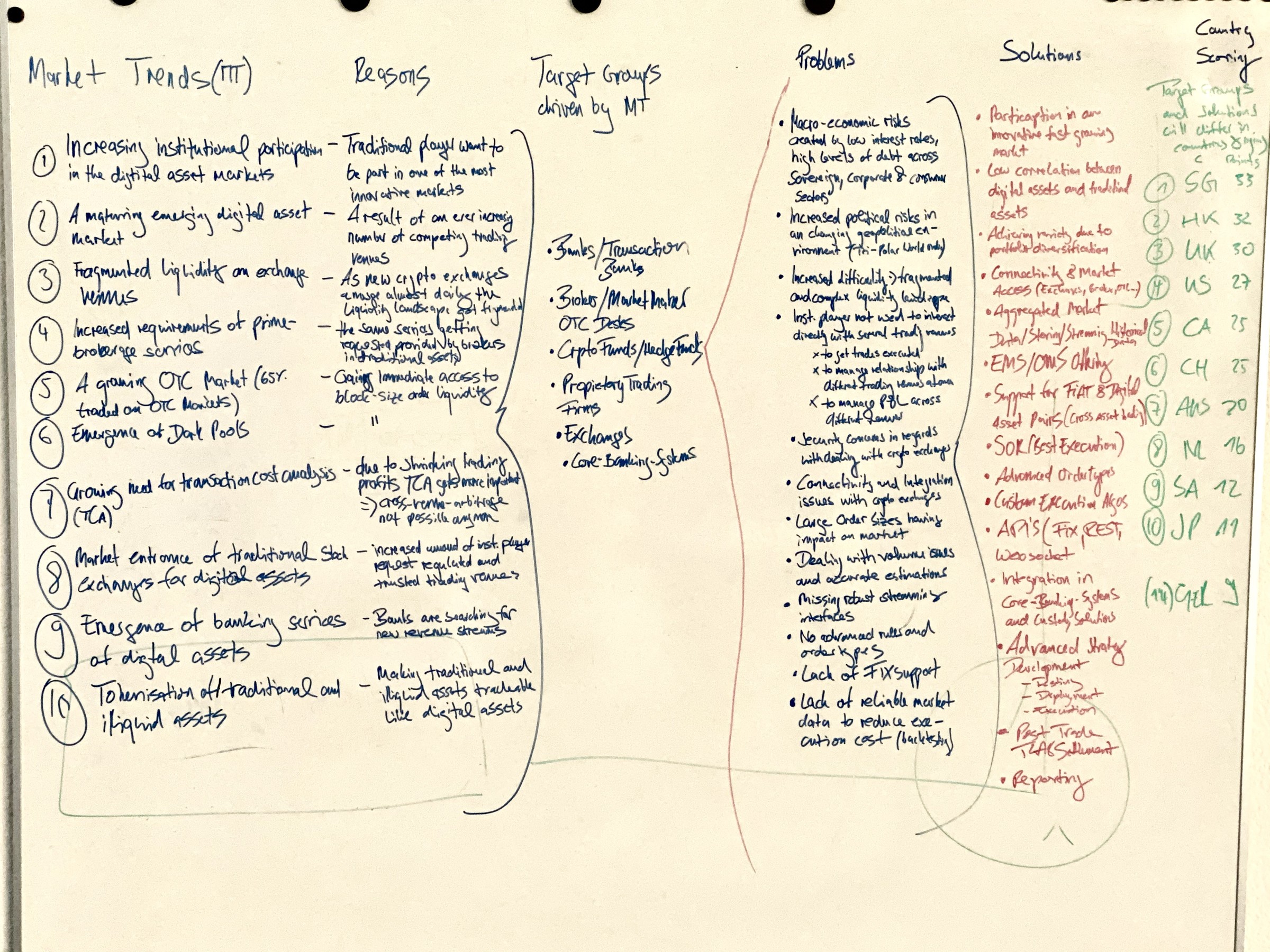
The first sketch of the Three Universal Laws. Drawn four years before any AI language model became publicly available.
Sketched at an office in Zurich. The board maps the direction of the markets, the forces driving them, the audiences they affected, the problems those audiences encountered, and the responses the market was developing. The structural logic that became the First, Second, and Third Laws is already on the board, in the language of practice.
Mehrhoff Research operates outside academia and outside industry. An independent science and research studio with no external funding, no board, and no university partnership. Founded 2019 in Zurich, domiciled in Tallinn, run from Bangkok.
The work is published open access. Every paper passes adversarial peer review before deposit. Every claim names the empirical conditions under which it would be falsified. Every citation traces to a primary source. The standard is not the institution. The standard is the work.
Deposited on Zenodo, permanently archived.
Data points analysed across all empirical validations.
Foundational and human decision-making.
No paywall, no journal embargo.

A horizon decades away. The daily practice of moving toward it. Seven principles the studio holds itself to, with or without anyone looking. Five codes the studio answers to when no external authority requires them. Each statement enforced internally. Each verifiable from outside.

Vision and mission, stated directly. What the studio is working toward, and what it does today.

Seven standards held against every paper, every conversation, every relationship the studio enters. Decision-making, rigour, independence, transparency, originality, curiosity, and courage.

Self-regulated science. Published standards, open methods, full results regardless of what they show.
Press, academic peers, conference organisers, policy bodies, industry practitioners, and readers reach the studio here.
Six formats, from public keynote to closed doctoral seminar. The full range is welcome; the substance of the questions decides the invitation.
Four positions, from visiting researcher to fellowship, with two scheduled per calendar year. A residency produces sharper work than a single talk because the conversation extends.
Press kit with bios, headshots, and topic briefs is ready to download. Lectures, learning materials, and the architecture itself are licensable.