
Most researchers spend a career inside one domain. Patrick Mehrhoff worked as a practitioner at six of the frontiers that redefined how society organises information, money, and value over seventeen years. The consumer internet, Swiss fintech, European monetary policy, Southeast Asian financial markets, institutional crypto assets, and the first wave of applied AI. At every frontier, the same structural observation appeared at a different scale. Since 2019, on a whiteboard in Zurich, it was looking for a name. This is the path that produced it.

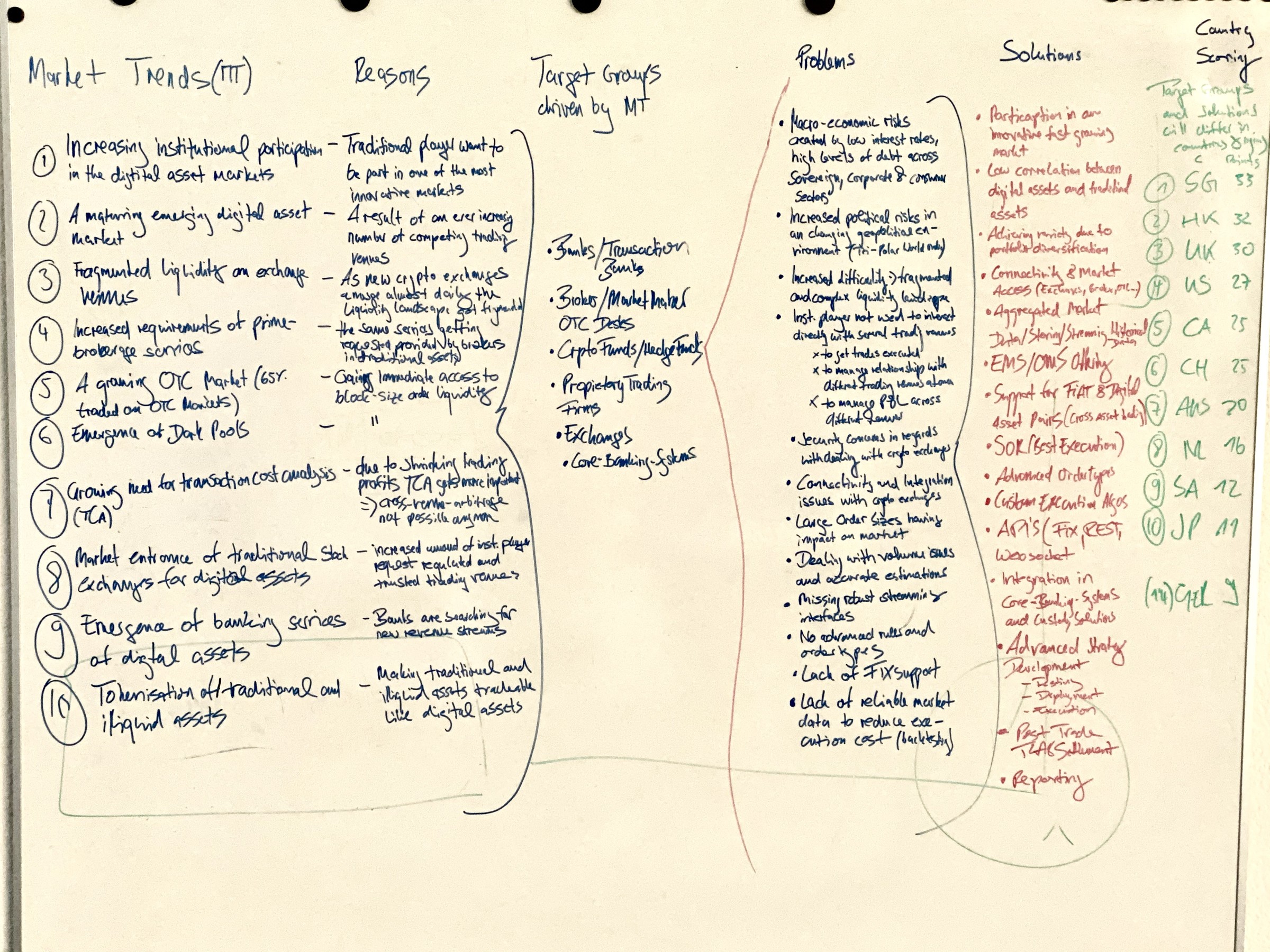
There is a whiteboard, photographed in Zurich in 2019, that contains the complete logic of three theories that did not yet have names.
The man holding the marker had no doctorate, no laboratory, and no faculty position. He had a notebook full of observations from a decade of cross-market work, a position in cryptocurrency that he had been holding since 2013 when buying Bitcoin still meant a peer-to-peer transaction with another individual on Bitcoin.de, and a 2015 article that described Bitcoin as a future reserve asset, written five years before the corporate treasury wave made the thesis mainstream.
Whatever else he was, by every standard the institutional research system uses, he was not a researcher.
Seven years later, the work on that whiteboard has produced more than fifteen papers, three formal theories, the empirical demonstration of domain invariance across biological, artificial, hybrid, and quantum agents, and the studio that exists to carry it forward. None of it was funded by anyone. None of it was directed by an institution. The man with the marker built every part of it himself.
The story of how this happened was, on inspection, less unusual than it sounds. The pattern that ended on the whiteboard had been forming for years, and the operational habits that produced it had been forming for longer.
Six frontiers. Each one a different industry, a different country, a different decade. At every stop, the same structural observation appeared at a different scale. The path did not produce the theories. It produced the conditions under which the theories became inevitable. The 2019 whiteboard is the moment the pattern recognised itself. Bangkok, at the right, is where the work is published today.
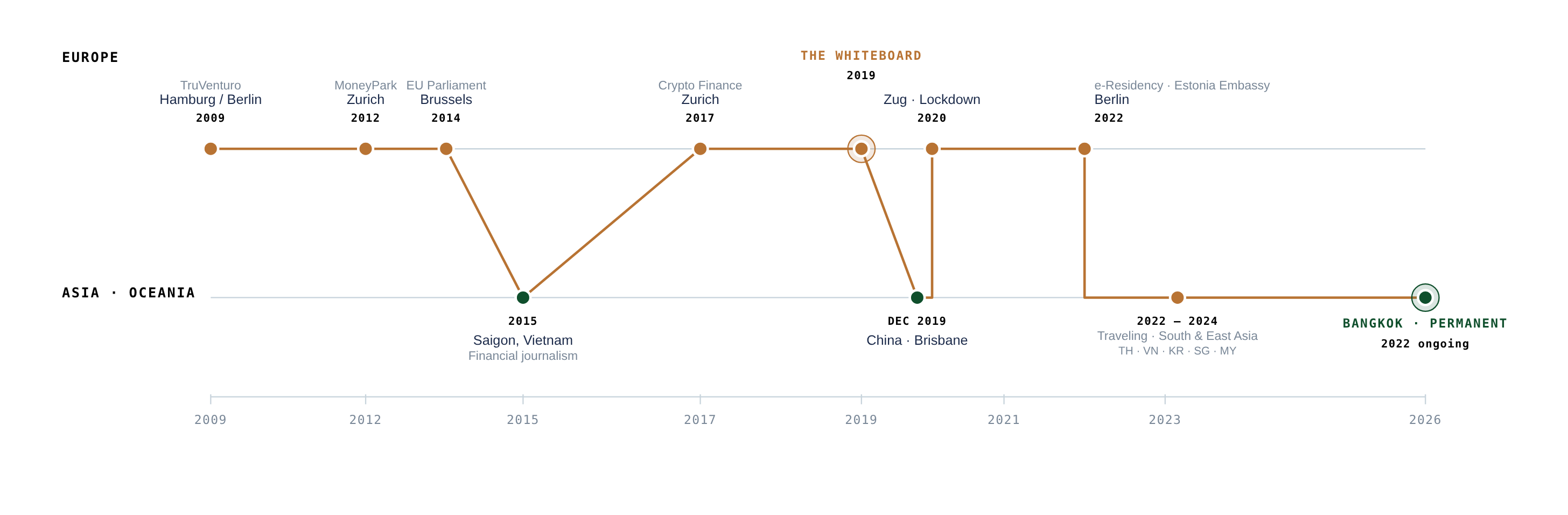
The first chapter began in Hamburg, at the end of his military service, with a job at TruVenturo.
One of the most successful German startup incubators of that generation, it operated alongside Rocket Internet during the same period that was assembling the foundations of the modern German internet economy. TruVenturo ran its portfolio out of three offices within walking distance of each other across central Hamburg. HafenCity, at the southern edge of the city. The Colonnaden, at the Alster. Hohe Bleichen, between them. The clustering was deliberate. A founder from one company could cross the road and have lunch with the marketing lead from another. A conversation about user acquisition that started in one office could be carried into another by dinner. The whole operation was designed so that the learnings of one company would not have to be paid for twice by the next.
He ran SEO across the portfolio, which meant he had no fixed office. Beaufort/Media one morning, with helpful.com and hilfreich.de. Finanzcheck next. Casamundo after lunch. Independent Publishing and Pictorama on Wednesdays. Solegro, Videobeat, Dreamlines for the rest of the week. A dozen or so companies depending on the year, each one with its own product, its own audience, its own competitive position, and its own version of the same structural constraint. A single page had to satisfy two entirely different kinds of reader at once. The human user, arriving with a question. The search engine, ranking the answer against every other page that had attempted it. Both had to be served by the same prose, under the same rules. Intelligibility did not depend on which kind of reader was doing the reading. That observation was not theoretical. It was the product of a job in which the stakes of getting it wrong were visible by the following Monday.
It was a factory floor for ventures that had to work in markets that did not yet exist. The method was parallel testing, fast iteration, and ruthless triage of what was not working. That method would become the operational logic of everything that followed. He had been working substrate-invariant from the first frontier. Fifteen years passed before the research program would name the thing he had been doing.
Zurich in 2012 was the obvious next city for someone who had spent three years building internet ventures in Hamburg and Berlin. The scale was different, the register was different, and the problems were more consequential. He joined MoneyPark as one of the first employees and helped build the SEO and marketing infrastructure that would turn a startup mortgage broker into Switzerland's largest independent broker before Helvetia acquired it in 2016.
The constraint from Hamburg sharpened. In Hamburg, there had been two readers. In Zurich, there were three. A Swiss consumer comparing loan options across a market they had never been able to see in full. The search algorithm ranking that content against thousands of competing pages. A financial regulator who would later read the same content under consumer-protection lenses. Three kinds of reader. One page. One structure. The same discipline applied, under significantly less tolerance for ambiguity. He was learning how regulated industries absorb digital transformation, and what the pattern of adoption looks like when an incumbent sector is forced to compete with a transparent platform.
Banks, pension funds, and insurers were all already selling the same mortgages. The product was unchanged. What MoneyPark introduced was the position from which the customer could see the whole market: a full overview at a glance, comparison work done by specialists rather than by the customer themselves, and a fully digital process. What had been invisible at one channel became transformative through another. The product had not changed. The position had. Over those years, the investor segmentation work of those years, watching how people decided to trust one channel over another, eventually became the empirical foundation of the first of the three theories. The theory was not published until 2026. The observation was made in Zurich in 2012.
In late 2014, the work moved to Brussels and the European Parliament, where he spent the next year working as a digital advisor to a sitting Economist on monetary policy. The office sat on the rue Wiertz, the long institutional corridor that runs along the south face of the Parliament building. The walk to work crossed the Place du Luxembourg, where lobbyists, policy researchers, and committee staff met at the same cafes from eight in the morning until midnight, swapping the same intelligence in all European or more languages.
In January 2015 he watched Mario Draghi announce the European Central Bank's expanded asset purchase program from the Parliament floor. Over the months that followed, he watched the institution that surrounded that announcement try to absorb its consequences. He learned how supranational institutions actually work, what they are good at, and what they cannot do regardless of the resources directed at them. The lesson was not what the press gallery had been writing. It was structural.
Parliament committees and regulated financial markets ran on the same logic. Access was controlled. Information was held asymmetrically. Value flowed from those who needed the apparatus toward those who managed it. Swiss mortgage distribution and European monetary policy were operating at radically different scales, and yet the same pattern was running in both.
The notebook was filling with the same observation in three different cities.
Almost a decade before institutional capital began describing Southeast Asia as the future, the work moved to Saigon in 2015.
The next few months he was covering Singapore, Vietnam, and Malaysia at a financial journalism startup, working out of an office in District 1 where the building hummed every few minutes from the press of motorbikes through the streets below. The Singapore desk handled the institutional reporting. The Vietnam desk handled the founder economy, the early fintech ventures, and the long-overdue work of explaining a financial market to the population it was being built for.
He was responsible for publishing the first formal Fintech Industry Report on Vietnam, mapping the structural conditions of an emerging-market financial sector at the moment its trajectory was being set. The work required learning the region from inside, not as a Western observer passing through, but as an operator in markets the formal sector had not yet reached. That distinction mattered then. The Asia perspective that runs through the research program is built on actual residency, not on familiarity accumulated during visits.
The third repetition of the pattern arrived almost on schedule. The same dynamics that shaped Swiss mortgage distribution and Brussels monetary policy also shaped how financial knowledge moved through populations the formal sector had not yet reached. Three different rooms. One identical structure.
The return to Zurich was the discovery phase. He joined Crypto Finance, the first FINMA-regulated provider of trading, custody, and investment services for digital assets, at the moment institutional capital was beginning to take the asset class seriously.
The company began in the Crypto Villa, a townhouse-turned-office that suited the scale of a market still finding its institutional language. It moved into the Prime Tower as the language became fluent, the glass skyscraper at Hardbrücke that had been Zurich's tallest building since 2011 and was now filling, floor by floor, with the traders, custodians, and protocol engineers who had left traditional finance for a market moving considerably faster than the one they had left.
The Villa-to-Tower move was itself the cascade in miniature. Institutionalisation, made visible in a single company's choice of office.
Over the next two years, he watched crypto asset markets do in months what traditional financial markets do in decades. That speed was the gift. The cascade dynamics that had been hiding in slower markets became visible at the pace of observation.
Ignition. Polarisation. Institutionalisation.
The three phases, which play out across decades in bond markets and election cycles, compressed into windows short enough to watch their internal structure in real time. Eleven jurisdictions, compared in parallel, made the cross-scale identity claim impossible to ignore. The same sequence was running in markets separated by language, regulation, culture, and monetary regime. It was running in all of them.
The multiplicative logic was also becoming concrete. How trends, target groups, and structural conditions interacted was not an additive story. Change any single factor to zero and the outcome collapsed entirely.
By 2019, the observations were precise enough to put on a whiteboard. The whiteboard was at Wyden, the crypto infrastructure provider whose offices sit close to the Letzigraben in the city's industrial west. Some evenings, on the walk back to the train station after work, the streets would fill with the slow tide of supporters leaving Letzigrund stadium after an FCZ match. Zurich is a precise city, but it has neighbourhoods where precision gives way to something more communal, and Letzigraben is one of them.
The whiteboard was sketched in that part of town, four years before any AI language model became publicly available.
It was not the work. It was the moment the work became visible to itself.
Every airport has a theory about what an airport should be, and the theory tells you what the country thinks of itself. By December 2019, he had been through enough of them to read the genre. New York's JFK and LaGuardia had been monuments to American confidence in the 1960s and had aged into something else. Patched corridors. Scuffed floors. A subway between them that read less as transit infrastructure and more as a slow-moving portrait of what an American city does and does not take responsibility for. Singapore Changi was the opposite proposition. A botanical garden that also happened to be an airport, the orchid garden, the cactus garden, the butterfly house between gates, all of it built to remind arriving passengers that Singapore was a city worth noticing.
Guangzhou Baiyun, when he arrived that December, was operating at a register he had not seen before. One of the ten busiest airports in the world. Two terminals built for a daily throughput that has no equivalent in Europe. Higher ceilings. Wider corridors. The moving walkways emptier because the space was so generous that the foot traffic dissolved before it could crowd. Not a botanical garden. Something more confident than that. A people's statement about what a country was now capable of, rendered in steel and glass and arrivals boards. It was difficult to walk through it without concluding that the centre of the global economy had quietly moved, and that the rest of the world had not yet caught up to the announcement.
The country he arrived in did not yet know what was already moving through it.
He continued on to Brisbane over Christmas, a reunion with a friend from the Hamburg years, from the portfolio companies and the shared mornings between HafenCity and Hohe Bleichen. Brisbane in late December is neither. Subtropical summer. The Brisbane River winding through the city with the unhurried curve of a country that has never confused infrastructure with insistence. The old sandstone of the Customs House and the Treasury, standing where they have stood since the colony was new. Queenslander houses lifted on their stilts to catch the breeze. The whole place carrying the Australian laissez-faire elegance that does not need to convince anyone of anything. They saw in the new year together somewhere in that warmth, with no particular awareness that 2020 was the year everything would change.
He returned through Shanghai in the first days of January, a different airport and the same ordered confidence, the same arrivals boards cycling through destinations on schedule, with no reason to look at the city any differently than he had looked at Guangzhou three weeks before. By February the news had gone global, and the journey that had begun as a reunion between old colleagues had become an accidental reconnaissance of the early geography of a pandemic he had quietly traveled through without knowing.
What he had passed through closed within weeks. International travel paused. Borders sealed. By the time he understood, the world had changed and a chapter was about to close.
He would later use the data it produced. The pandemic played out across more than a hundred jurisdictions over three years, with a cascade clarity that no designed study could have achieved. Ignition in the first Wuhan reports. Polarisation in the divergent national responses, the contested science, the fractured politics. Institutionalisation in the endemic frameworks that settled over the years that followed. It was one of the most rigorous empirical tests the UCT would ever receive.
The theory held.
Zug in the spring of 2020 was the quietest he had ever seen a Swiss town be. The pandemic had emptied the streets. Lake Zug sat untouched except for the occasional sailor who had decided that the rules did not apply to them. The forest paths into the hills above the town were busier than they had been in years because they were the only public spaces still functioning. He had taken an apartment five minutes from the lake, on a street that ran toward the water, with views toward the Alps on a clear day. The kind of access to water and forest that turned a stalled year into a long training period.
He ran the lake path most mornings. Read in the afternoons. Built the agency in the evenings, the consultancy that would later be called Mehrhoff Digital and would carry the unpublished theories into their first commercial application. The pandemic had given him the kind of interior period that does not usually come to a person who has spent most of his life looking for the next adventure. He recognised, slowly at first and then plainly, that the Swiss chapter that had defined the previous decade was closing. Eight years between MoneyPark, Crypto Finance, and the whiteboard at Wyden. The work the country had given him was done. The work it could give him next was somewhere else.
By the time international travel began to reopen, he had already made two arrangements. The first was a trip home, to visit his parents and then onward to Berlin to collect his Estonian e-residency from the embassy, which would let him incorporate Mehrhoff Digital in Tallinn within days of his return. The second was a one-way ticket to Bangkok, booked for one of the first commercial flights to fly the route after the borders reopened.
The plane was almost empty. So was Suvarnabhumi at the other end. The immigration queues that normally stretched for an hour were cleared in minutes by officers who had not seen a full flight in months. He stepped through customs into the Bangkok warmth, into a city that had not yet recovered the population of tourists and business travelers that defined its normal rhythm, and that for the moment belonged disproportionately to the people who had chosen to be there. He was one of the few already moving while the rest of the world waited.
The first thing crypto teaches is that conviction and price are not the same variable. He had bought his first Bitcoin in 2013, when buying still meant a peer-to-peer transaction on Bitcoin.de between two individuals matched by the platform, and the asset class spent the years that followed building its own grammar in public. Charts were noise until they were not. Patterns emerged after enough hours of looking. The discipline of reading them was the discipline of reading any market that runs faster than its participants can absorb. Trading taught him what only trading teaches. The connections appear obvious to those who have stood inside a market when it moved. They stay invisible to everyone else, however learned the observer. The market does not care what the analyst believes. The analyst is right to hold the belief regardless, but should be careful which day he expects to be paid for it.
The cost of conviction was not only paid in price. At a wedding back in Germany in 2018, he tried to explain what he had been seeing at Crypto Finance to friends he had known since childhood. They told him the asset class was a scam. He was told to stop pretending he understood what the rest of them could see plainly. The friendships did not survive. He had wanted them to thrive and prosper. He had wanted them to have the financial freedom to build whatever life they chose for themselves. The offer was real. He found out that conviction can be a lonelier asset to hold than the one that produced it.
The other thing the lockdown produced was the financial freedom to make the next several years possible. His position, held since 2013, entered a new bull cycle through 2020 and 2021. The early conviction that had produced the 2015 reserve asset article finally produced its returns. The position funded the agency, the research, and the travel that followed.
It also produced the losses that taught him what holding actually costs. When the Chinese crypto ban hit in September 2021, it took a meaningful piece of the position before he could move, and he took it in full because the conviction was correct even when the price was not. The Luna collapse in May 2022 was a different kind of signal. The algorithmic stablecoin UST had been attacked at the Curve liquidity pool by parties never publicly identified. Defending the peg required the mechanism to issue Luna into infinity, which destroyed the asset that backed it. Sixty billion dollars erased within days. He read the event for what it was. A liquidity shock large enough to break the structure of the market. The unmistakable end of what crypto traders call the moon period. He reduced the position on the first recovery, before the implications had fully spread.
Celsius failed in June. Three Arrows Capital followed in July. The FTX collapse in November was the final domino, an exchange running on co-mingled customer funds that was one tweet away from a bank run, and the tweet came. He had already sold his full position. The same operational instinct that had carried him into the asset class in 2013 had carried him out of FTX in time. What he had watched, across seven months, was a cascade nested inside other cascades. Luna had set off the conditions that took Celsius and Three Arrows together. Their collapse had deepened the bear market into the one that exposed FTX. Each link at a different scale, each through a different mechanism, all running on the same underlying logic he had drawn on a whiteboard three years earlier.
The discipline he had learned in the German incubator applied to a personal portfolio with the same accuracy it had applied to ventures. Parallel testing. Fast iteration. Ruthless triage of what was not working. He kept the conviction. He cut the exposure to cash and stayed there for years.
The hodler mindset that crypto culture had built into its identity was the most mentally draining position a trader could hold. A position that multiplied many times and then gave it all back was experienced as the loss of the gain that had never been realised, not as the preservation of the capital that remained. Bear markets in crypto last two or three years. Every day during those years was a decision not to sell. The market traded around the clock, which meant disengagement was not available. The trader who took profits at the top and waited in cash had none of these costs. He had realised gains, a defined position, and the option to re-enter at the bottom. The discipline that crypto culture mocked as a lack of conviction was the cleaner conviction, the one that did not require suppressing reality to maintain itself. He had learned it by holding through prior bear markets.
He re-entered near the bottom of the cycle that followed, with the same conviction that had carried him into the asset class twelve years earlier.
The position carried the rest of the work.
For the first time in fifteen years, the schedule was his to set. He brought it to Southeast Asia, where more than half of the world's population lives and where the future of the global economy was assembling itself considerably faster than the coverage suggested. The previous visits had been as an observer. This time he was a resident, on capital he had earned and on time he had finally given himself. Days were his to design. Travel. Reading. Taking notes on the patterns assembling themselves in countries and cultures he had only seen from the outside. Learning what it was to enjoy a life that did not run on someone else's schedule.
The agency he had prepared during the Zug lockdown continued, but the spaces where it ran were different. A balcony in Hoi An overlooking the lanterns over the Thu Bon river. The coffee shop in Da Nang where the espresso came in shot glasses and the wifi held steady from eight in the morning until midnight. A serviced apartment in Bangkok on the river side of the Chao Phraya. The work itself was a marketing operation focused on fund management, wealth management, and financial services, the same industries he had spent the previous decade inside. It was structurally portable. The texture of each working day was set by the city he was inside.
He moved between Thailand and Vietnam for years, with week excursions to Kuala Lumpur, Seoul, Busan and Singapore. Longer stays at the beaches in Da Nang, Nha Trang, and Phuket. From Da Nang he ran the scooter up the coast to Hue and the older traditional cities the tourist brochures had not yet flattened, then west into the mountains as far as the Laos border. Those were the trips where the thinking happened. Hours on a scooter with the road folding into mountain passes is a particular kind of thinking, the kind where ideas surface that would not have surfaced in front of a screen. In September 2022 he lived through his first typhoon. Noru paralysed Da Nang for several days, and he watched it from a hotel room as the wind reorganised the geography of the street outside.
The seed of a book had been planted in Phuket, earlier that year. A street artist was sketching a tourist's portrait for three hundred baht. Sitting next to them, the tourist's daughter was generating an anime version of herself on a phone in about eight seconds. Years of training sat across from eight seconds and a free download. Nobody had given the artist the language to explain why one was worth more than the other, and the tourist had no way of knowing there was a gap to explain. That question, visible on a folding chair by the beach, would stay with him for the next two years.
Bangkok was the working base. Mornings went to triathlon training, swimming, running, cycling, in the disciplined rotation of a sport that rewards the person who shows up. Afternoons went to the agency, to the writing of a book he had been turning over in his head, to the first drafts of the papers that would later become the Mehrhoff Research Program, and to the new business ideas the travel kept handing him. There were no vacations in the conventional sense. The theories were always running. Every pattern at a hotel pool, every conversation overheard at a market, every signal from the local economy was material. The enjoying had finally caught up with the working. Work and life had stopped being separate categories.
The commercial center of the agency was FundMarketers, a financial marketing operation built directly on the unpublished theories. It served the industry he had been operating in since 2012, fund and wealth managers, an industry whose marketing was almost entirely produced by people who had never worked inside the products they were selling. He had. The Mehrhoff Framework for investor segmentation was written during this period and published through FundMarketers as a series of practitioner ebooks. It was the first publication of the IADT thinking, three years before the IADT itself was deposited as a paper, and it worked in the field for the same structural reasons it would later survive academic scrutiny.
The travel was the last reconnaissance before Bangkok became permanent, for reasons that are not part of this story but mattered to its outcome.
The first commercial test of the theories came from Switzerland in 2023. BFI Capital, a Swiss asset manager, engaged the agency. The audit was straightforward enough. A unification strategy was not. No other consultant available to them knew the theory existed. It had not been published. It existed in one head and one set of working files, in Bangkok. Hiring the agency was, in effect, the only way to access it.
It began with a single website. BFI Consulting had asked for help with altalphastrategies, the marketing site for the group's alternative investment funds. The first session made the structural problem readable. They had been maintaining their brand portfolio the way a road crew patches a highway, filling individual holes without ever rebuilding the road bed underneath. The discovery audit on altalphastrategies surfaced a finding the group had not yet read for what it was. They had recently rebranded one portfolio company from Global Gold to BFI Bullion. The audit recognised that rebrand as the beginning of a unified naming convention that already ran across BFI Capital, BFI Consulting, BFI Infinity, and then BFI Bullion. With altalphastrategies counted in, the group ran four companies on five websites. The agency prepared the case across more than a dozen presentation slides over a month and a half. The recommendation worked on top of the existing reality the group had already created, rather than against it. By the end of that work, BFI had changed direction. They asked for a full unification audit and strategy across the whole BFI Capital group.
The work shipped. On time, and to specification. The audit went deeper than the brand-naming layer, mapping how each product line was actually chosen by the investors who bought it. The strategy laid out a single coherent group presence, built on a diagnostic framework for how investors actually decide what to trust. Within months, the group built their own unified Webflow site. The strategy had laid the road bed for a high-speed highway. What they paved on top was their execution.
That part was used. The deeper work did not. The investor segmentation framework, the full logic for how each product line should speak to its actual buyers, stayed in the audit folder. He had learned in the crypto markets that conviction and price are not the same variable. BFI taught him that conviction and execution are not either.
The relevant fact for this story is that the theory worked.
The question that had been sitting with him since Phuket found its answer in Bangkok. The art scene was younger and more restless than most of the Western art world had yet noticed. Bangkok Art Biennale anchored it. The gallery district fanned out from Charoenkrung Road into Chinatown. The conversations happened in cafes in Charoenkrung or Ari or Thonglor at three in the afternoon, with the artist choosing carefully which truths to share and which to hold back, and then deciding to share those too.
He conducted field research across Bangkok's art fairs and the wider Asian gallery network, in conversation with hundreds of working artists about what determines whether a creative career compounds or stalls. Twenty-two became full case studies, each one tested against the four-force model, each one read as a UCT cascade in motion. The same multiplicative logic that had governed Swiss mortgage distribution and Zurich crypto asset markets also governed the difference between a working artist and a famous one. The work became a business book for artists, written for the creative industry and grounded in the same empirical discipline that produced the academic papers. Publication is forthcoming.
The art world also handed him the operating model for the rest of the studio. He had been studying Peter Paul Rubens for a chapter in the book, the great Antwerp painter who ran one of the largest studio operations in the history of Western art. Dozens of assistants. Multiple simultaneous commissions. Tiered pricing depending on how much of the canvas was by his own hand. The Rubens workshop was not a compromise of the master's creative authority. It was the operating mode that made the master's creative authority scalable. Looking at the same diagram with one eye on Antwerp and one eye on his own working pattern in Bangkok, the operating model for Mehrhoff Research became suddenly visible. A founder at the centre, designing every composition and holding every quality standard. The studio that publishes the research today was modelled on a painter who died in 1640.
What followed was the part that took everything the prior decade had not. Five years of independent work, conducted from Bangkok, without institutional affiliation, without external funding, and without the publication apparatus most academic researchers take for granted. Self-financing came from continued commercial work and from positions taken in the markets the research was simultaneously studying. Formal credentials at MoMA, Bocconi, California Institute of the Arts, Copenhagen Business School, Oxford Said Business School, and the University of Hong Kong were earned during this period. The credentials were instruments. The work was the work.
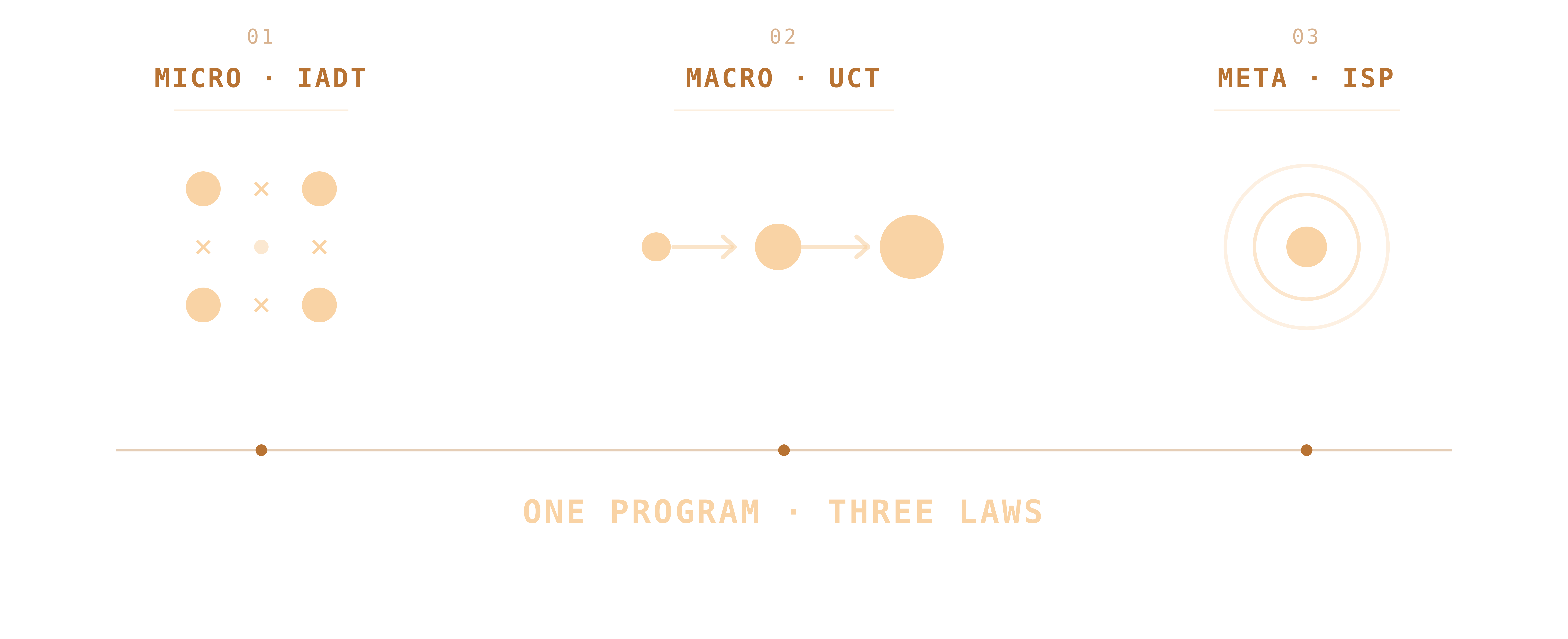
By the end of the period, the whiteboard had become a body of work. Fourteen peer-reviewed papers were deposited openly on Zenodo with permanent DOIs. The validation set had grown to more than 87,000 data points across multiple substrates. The three theories had taken the form they were now known by, the Three Laws of Decision-Making. At the micro level, the Integrated Action-Driver Theory replaced the additive consensus on how individual decisions are governed. At the macro level, the Unified Cascade Theory explained how individual decisions aggregate into systemic outcomes. The Identical Scale Principle provided the meta-level criterion for when cross-scale analogies are scientifically valid. Together they formed a complete micro-macro-meta architecture that no other research programme had assembled. A business book for artists, grounded in the same empirical discipline that produced the papers, stood ready as a manuscript for publication.
The substrate invariance claim, the most consequential prediction the original sketch had made, was demonstrated empirically across biological, hybrid, artificial, and quantum substrates. Across financial market data, policy compliance records, algorithmic trading, chess engine play, and the art market with 1,018 transactions, the same multiplicative structure appeared. These were not analogies. They were structural laws operating at different scales of the same underlying phenomena.
The 2019 whiteboard had been proven right by the work that followed.
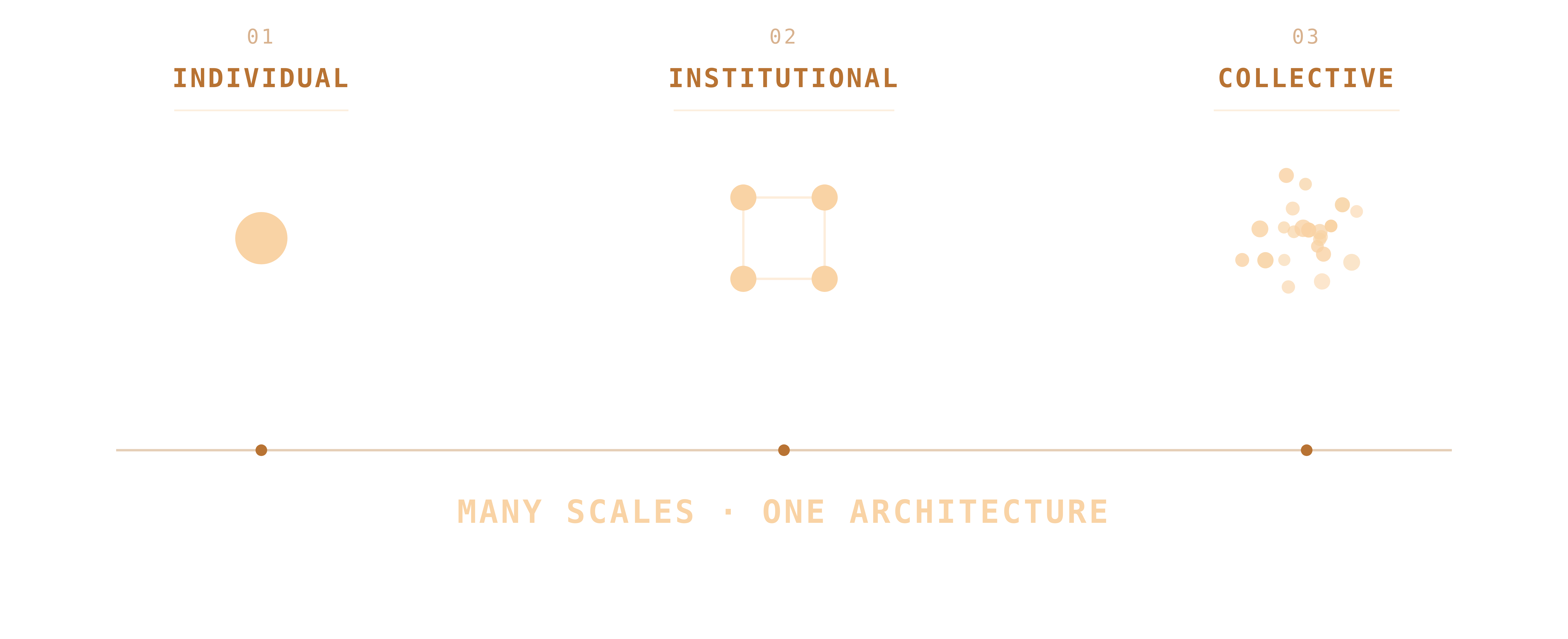
Decision outcomes are governed by structural forces, not by stable attributes. The same multiplicative logic recurs at three scales and across domains.

Action under complexity is determined by the dynamic interaction of four forces. The interaction itself is the mechanism. Additive models systematically under-perform because they cannot represent it.

How individual decisions aggregate into institutional outcomes through three sequential phases. Ignition. Polarisation. Institutionalisation.

A criterion for when a structural pattern recurs across scales and domains. The pattern transfers only where structural identity holds.
Patrick Mehrhoff is a German entrepreneur, independent researcher, AI engineer, and author. He is the author of the three original theories that constitute the Mehrhoff Research Program. He built the work the studio carries.
Most practitioners spend a career inside one domain. He worked as a practitioner at six of the frontiers that redefined how society organises information, money, and value over the last two decades. The consumer internet, Swiss fintech, European monetary policy, Southeast Asian financial publishing, institutional crypto assets, and the first wave of applied AI.
The same structural observation appeared at every frontier. By 2019, on a whiteboard at crypto infrastructure provider Wyden in Zurich, the pattern had become visible to itself. It did not yet have a name. Four years before any AI language model became publicly available, the complete logic of the Three Laws of Decision-Making was already on the whiteboard.
The studio was built from Bangkok, without institutional affiliation and without external funding. The Rubens workshop model defines how it operates. The founder sets the intellectual direction at every decisive step. The tools and collaborators execute within it.

Tested against nine foundational scholars, three of them Nobel laureates, and across fifteen structural dimensions. Every cell is independently challengeable.
Every dimension independently challengeable.
Most frequently cited as predecessors.
Among the nine scholars tested.
Confirmed across all nine scholars.

The three laws describe the same multiplicative structure that governs decisions across scales. What each audience recognises in them is different. Each doorway below opens into the same set of laws, framed for the way you are most likely to find your own work inside them.

The literature in your field has been reporting tail-failure for decades. Outliers, noise, model misspecification. The three laws name a different culprit. The structural form of the model itself. Read the laws and find the place where the assumption you never questioned has been doing the work all along.

Every senior decision-maker has watched a model work on average and break where the decision mattered. The three laws name what is happening. The breakage is not an edge case the model failed to anticipate. It is the multiplicative architecture finding its zero. Read the laws and the pattern beneath every model break of your career becomes legible at once.

Each major institutional cascade of the past fifteen years was investigated as if it were unique. The reports document different operational failures in different sectors. The three laws read across the reports and recognise one structural pattern. Read the laws and the recurrence stops looking like coincidence.

Every philosophical tradition that has tried to describe the world has eventually arrived at the same conclusion. The three laws turn the conclusion into a working structural explanation. Decisions form. They cascade. Their patterns transfer across scales. Read the laws the way our studio reads them.

Most foundational research is finished before a student arrives. The three laws sit early enough in their life that the field around them is still to being created. A graduate student who reads them now enters a body of work inside its formative window. The reading path is curated for entry from any quantitative or social-science background.

Universities train within additive frameworks. Journals review within them. Regulators write rules under them. Funders evaluate against them. The three laws name the structural assumption beneath the entire foundational layer. It has been invisible because no curriculum, no review, no framework has ever required it to be examined. Read the corpus and the link your institution has been operating without becomes legible.
The first program states the architecture and demonstrates the laws that govern it. The second tests those laws against the empirical record of human decision-making. Together they establish the studio's canonical core and its first empirical substantiation. Further programs are in active preparation.
The three laws at the micro, macro, and meta scales, derived and stated formally. Plus the empirical evidence that the multiplicative architecture holds across biological, artificial, and hybrid substrates. Every paper in every other program traces its structural claims back to this canonical core.
The laws tested against the empirical record from every sector, industry, and discipline where humans make decisions. From financial risk to clinical judgement to educational selection to electoral behaviour, the same multiplicative architecture governs the outcome. Every test in the program substantiates the structural finding the foundational program advanced.
The first sketch of the Three Universal Laws. Drawn four years before any AI language model became publicly available.
Sketched at an office in Zurich. The board maps the direction of the markets, the forces driving them, the audiences they affected, the problems those audiences encountered, and the responses the market was developing. The structural logic that became the First, Second, and Third Laws is already on the board, in the language of practice.
Mehrhoff Research operates outside academia and outside industry. An independent science and research studio with no external funding, no board, and no university partnership. Founded 2019 in Zurich, domiciled in Tallinn, run from Bangkok.
The work is published open access. Every paper passes adversarial peer review before deposit. Every claim names the empirical conditions under which it would be falsified. Every citation traces to a primary source. The standard is not the institution. The standard is the work.
Deposited on Zenodo, permanently archived.
Data points analysed across all empirical validations.
Foundational and human decision-making.
No paywall, no journal embargo.

A horizon decades away. The daily practice of moving toward it. Seven principles the studio holds itself to, with or without anyone looking. Five codes the studio answers to when no external authority requires them. Each statement enforced internally. Each verifiable from outside.

Vision and mission, stated directly. What the studio is working toward, and what it does today.

Seven standards held against every paper, every conversation, every relationship the studio enters. Decision-making, rigour, independence, transparency, originality, curiosity, and courage.

Self-regulated science. Published standards, open methods, full results regardless of what they show.
Press, academic peers, conference organisers, policy bodies, industry practitioners, and readers reach the studio here.
Six formats, from public keynote to closed doctoral seminar. The full range is welcome; the substance of the questions decides the invitation.
Four positions, from visiting researcher to fellowship, with two scheduled per calendar year. A residency produces sharper work than a single talk because the conversation extends.
Press kit with bios, headshots, and topic briefs is ready to download. Lectures, learning materials, and the architecture itself are licensable.