
Mehrhoff Research operates outside academia and outside corporate research and development firms. That is not a gap in the arrangement. It is the arrangement. That means the work cannot borrow credibility. It has to create it. The standards are set internally, applied without exception, and held without compromise. By the time a paper reaches the public, it has already passed through the hardest adversarial review the studio knows how to construct.

What is in question is not whether science works. It is whether the system built around science over the last sixty years still serves that purpose.
The core problem is an incentive mismatch that has been building since 1960, when a tool for tracking how often academic papers were cited by other papers was adopted by universities as a proxy for research quality. Today it determines hiring, tenure, promotion, and funding across every academic discipline. The incentive is not to find the truth. It is to produce findings that get cited. Those are not the same thing.
The scale of the failure became measurable in 2015. In any other industry, a 64% quality control failure rate would end careers. In academic science, the incentive structure that produced it is still intact.
The publishing market compounds the problem. A reform movement that began in the early 2000s pushed for open access, making research free to read. The commercial publishers who controlled journal prestige absorbed the reform. They switched from charging readers to charging authors. Article Processing Charges now exceed one billion dollars annually. The prestige hierarchy stayed exactly where it was. The money changed direction.
The studio was founded outside these structures for one specific reason. The work crosses the boundary between all known disciplines. It sits in no single department. It moves at the pace the question requires. And it sets its own quality standard, because based on internal structural analysis of the science market, independence is not the studio's alternative to institutional legitimacy. It is the condition under which this work can be produced.

Mehrhoff Research was not founded to fill a gap in the academic literature. It was founded because a single observation on a whiteboard in Zurich in 2019 suggested that the way most quantitative science builds its models may be structurally wrong. The observation became three theories. The theories became more than 15 working papers. The papers are deposited open access, permanent and free, because a record that cannot be read is not a record at all.

A theory that crosses the boundary between all disciplines has no natural academic home. A claim that the same multiplicative architecture governs biological, artificial, and hybrid actors and agents fits no single department and accumulates citations in no single silo. A research program built on practitioner observation rather than academic derivation runs counter to grant-funded conventions. The studio model resolves the structural fit problem by removing the structure entirely.
Independence is not a marketing slogan. It is an operational choice with concrete consequences. No external funding. No institutional review board to align with. No tenure clock. The studio gives up the legitimacy that academic affiliation confers. In exchange, it keeps the freedom to follow the question wherever it leads.
What the studio retains is the discipline of the academic standard without the academic institution. Every paper passes adversarial peer review before deposit. Every claim names the empirical conditions under which it would be falsified. Every citation traces to a primary source.
The standard is not the institution. The standard is the work.
Patrick Mehrhoff is a German entrepreneur, independent researcher, AI engineer, and author. He is the author of the three original theories that constitute the Mehrhoff Research Program. He built the work the studio carries.
Most practitioners spend a career inside one domain. He worked as a practitioner at six of the frontiers that redefined how society organises information, money, and value over the last two decades. The consumer internet, Swiss fintech, European monetary policy, Southeast Asian financial publishing, institutional crypto assets, and the first wave of applied AI.
The same structural observation appeared at every frontier. By 2019, on a whiteboard at crypto infrastructure provider Wyden in Zurich, the pattern had become visible to itself. It did not yet have a name. Four years before any AI language model became publicly available, the complete logic of the Three Laws of Decision-Making was already on the whiteboard.
The studio was built from Bangkok, without institutional affiliation and without external funding. The Rubens workshop model defines how it operates. The founder sets the intellectual direction at every decisive step. The tools and collaborators execute within it.

Most research studios describe how they work. This one makes the description auditable. Every pillar below leaves a verifiable trace on the public surface of the work. The standard is either met or it is not.
Every paper deposited by the studio carries four invisible marks. The observation ground that produced the theory. The internal panel that attacked the draft. The falsification condition that names what would prove the theory wrong. The open access DOI that makes the record permanent. All four marks are required. No paper leaves the studio without them.
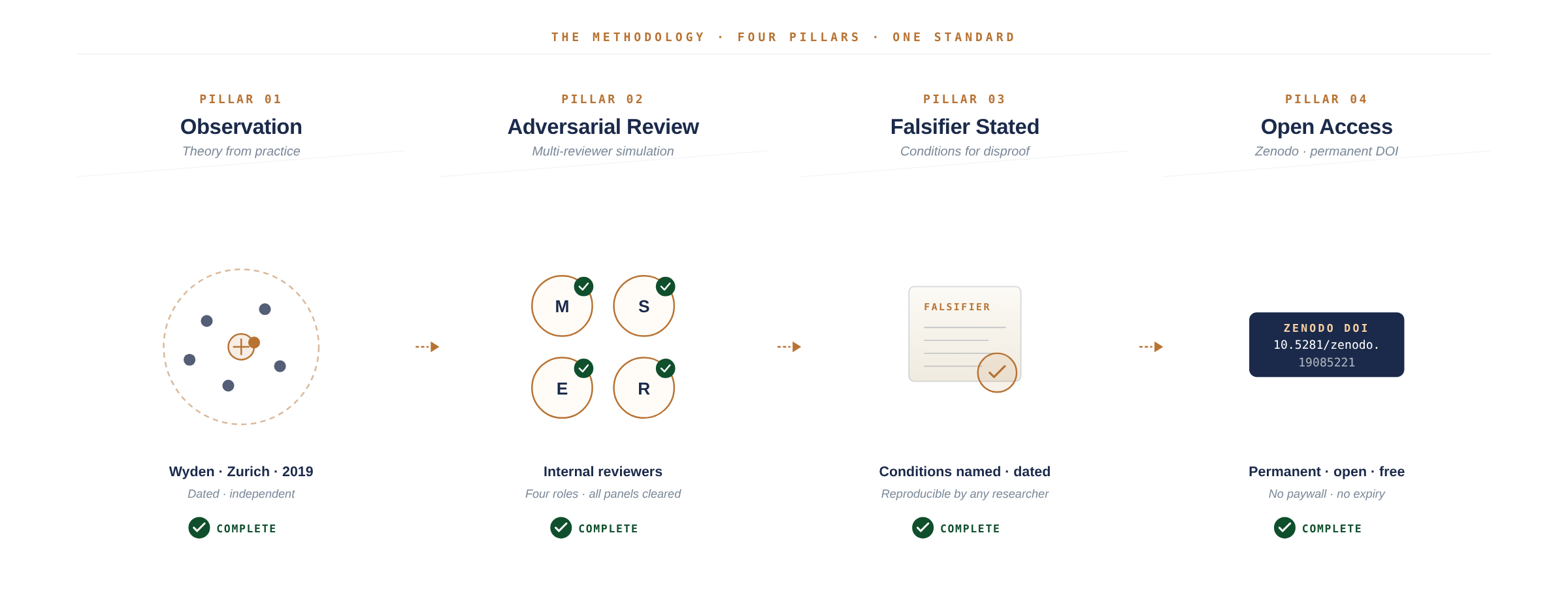
Theory grounded in observation, not derived from an existing literature.
The frameworks at the core of the studio were not derived from prior academic theory. They were observed in practice across financial markets, crypto infrastructure, and art markets, then formalised against the existing literature. The convergence of the multiplicative structure with established models is independent confirmation, not lineage. The observation came first. The literature was consulted second. This sequencing matters because it determines what the theory is responsible for. The theory has to fit the data the founder observed in the field, not the data the literature happened to collect.
The complete logic of all three laws was first sketched on a whiteboard at crypto infrastructure provider Wyden in Zurich in 2019, the four-force product of the IADT, the three-phase cascade of the UCT, and the structural identity principle of the ISP. The whiteboard photograph dates the sketches four years before any AI language model was publicly available, anchoring the intellectual independence of all three founding observations.
Every major paper survives multi-reviewer simulation before submission.
Academic peer review is single-pass and reviewer-dependent. The studio's adversarial review is multi-pass and reviewer-systematic. Each paper goes through an internal panel that simulates the worst plausible reviewer for that paper's specific weaknesses. The panel hunts for fabrications, structural inconsistencies, and unsupported claims before the paper leaves the studio. By the time a paper is open access or submitted to a journal, it has already been broken and rebuilt against its strongest internal critics.
One reviewer checks content accuracy and source-trace. One checks framing and writing rules. One checks the storyline structure top-down. One runs the structural audit against the studio's standing rules on vocabulary, formatting, and citation compliance. Every paper crosses every desk before it will be made publicyl accessible.
Every theory specifies what would disprove it.
A theory that cannot be falsified is not a scientific theory. The studio takes this standard literally. Each of the three integrated theories names the empirical conditions under which the theory would be wrong. The IADT can be falsified by finding a domain where one force at zero does not nullify the outcome. The UCT can be falsified by finding a cascade that does not follow three phases. The ISP can be falsified by finding a cross-domain mapping that passes all three criteria yet produces systematically wrong predictions. The conditions are concrete, dated, and reproducible. The studio invites the falsification work. A successful falsification is a contribution to the program.
Each working paper carries a falsification section. The conditions are stated in the same language the empirical methodology uses, so an outside researcher can run the test directly against the published data. If the falsifier is met, the studio updates the theory. Either outcome is informative.
All papers, all data, all analysis code on Zenodo with permanent DOIs.
Publication behind a paywall reaches a smaller audience than the work warrants. The studio publishes everything open access on Zenodo, with permanent DOIs that survive any institutional change. Data is deposited alongside the paper. Analysis code is deposited alongside the data. The entire chain from raw observation to published claim is reproducible by an outside researcher with no privileged access. Where journal submission is the right path for a particular paper, the open-access version remains the canonical reference.
All papers are deposited open access on Zenodo with permanent DOIs on the day they leave the studio. The Zenodo deposit is the primary publication. Journal submission follows where it adds value. The record is permanent regardless of the journal outcome.
A horizon decades away. The daily practice of moving toward it. Seven principles the studio holds itself to, with or without anyone looking. Five codes the studio answers to when no external authority requires them. Each statement enforced internally. Each verifiable from outside.

Vision and mission, stated directly. What the studio is working toward, and what it does today.

Seven standards held against every paper, every conversation, every relationship the studio enters. Decision-making, rigour, independence, transparency, originality, curiosity, and courage.

Self-regulated science. Published standards, open methods, full results regardless of what they show.
Decision outcomes are governed by structural forces, not by stable attributes. The same multiplicative logic recurs at three scales and across domains.

Action under complexity is determined by the dynamic interaction of four forces. The interaction itself is the mechanism. Additive models systematically under-perform because they cannot represent it.
How individual decisions aggregate into institutional outcomes through three sequential phases. Ignition. Polarisation. Institutionalisation.

A criterion for when a structural pattern recurs across scales and domains. The pattern transfers only where structural identity holds.
Tested against nine foundational scholars, three of them Nobel laureates, and across fifteen structural dimensions. Every cell is independently challengeable.
Every dimension independently challengeable.
Most frequently cited as predecessors.
Among the nine scholars tested.
Confirmed across all nine scholars.

The three laws describe the same multiplicative structure that governs decisions across scales. What each audience recognises in them is different. Each doorway below opens into the same set of laws, framed for the way you are most likely to find your own work inside them.

The literature in your field has been reporting tail-failure for decades. Outliers, noise, model misspecification. The three laws name a different culprit. The structural form of the model itself. Read the laws and find the place where the assumption you never questioned has been doing the work all along.

Every senior decision-maker has watched a model work on average and break where the decision mattered. The three laws name what is happening. The breakage is not an edge case the model failed to anticipate. It is the multiplicative architecture finding its zero. Read the laws and the pattern beneath every model break of your career becomes legible at once.

Each major institutional cascade of the past fifteen years was investigated as if it were unique. The reports document different operational failures in different sectors. The three laws read across the reports and recognise one structural pattern. Read the laws and the recurrence stops looking like coincidence.

Every philosophical tradition that has tried to describe the world has eventually arrived at the same conclusion. The three laws turn the conclusion into a working structural explanation. Decisions form. They cascade. Their patterns transfer across scales. Read the laws the way our studio reads them.
Most foundational research is finished before a student arrives. The three laws sit early enough in their life that the field around them is still to being created. A graduate student who reads them now enters a body of work inside its formative window. The reading path is curated for entry from any quantitative or social-science background.

Universities train within additive frameworks. Journals review within them. Regulators write rules under them. Funders evaluate against them. The three laws name the structural assumption beneath the entire foundational layer. It has been invisible because no curriculum, no review, no framework has ever required it to be examined. Read the corpus and the link your institution has been operating without becomes legible.
The first program states the architecture and demonstrates the laws that govern it. The second tests those laws against the empirical record of human decision-making. Together they establish the studio's canonical core and its first empirical substantiation. Further programs are in active preparation.
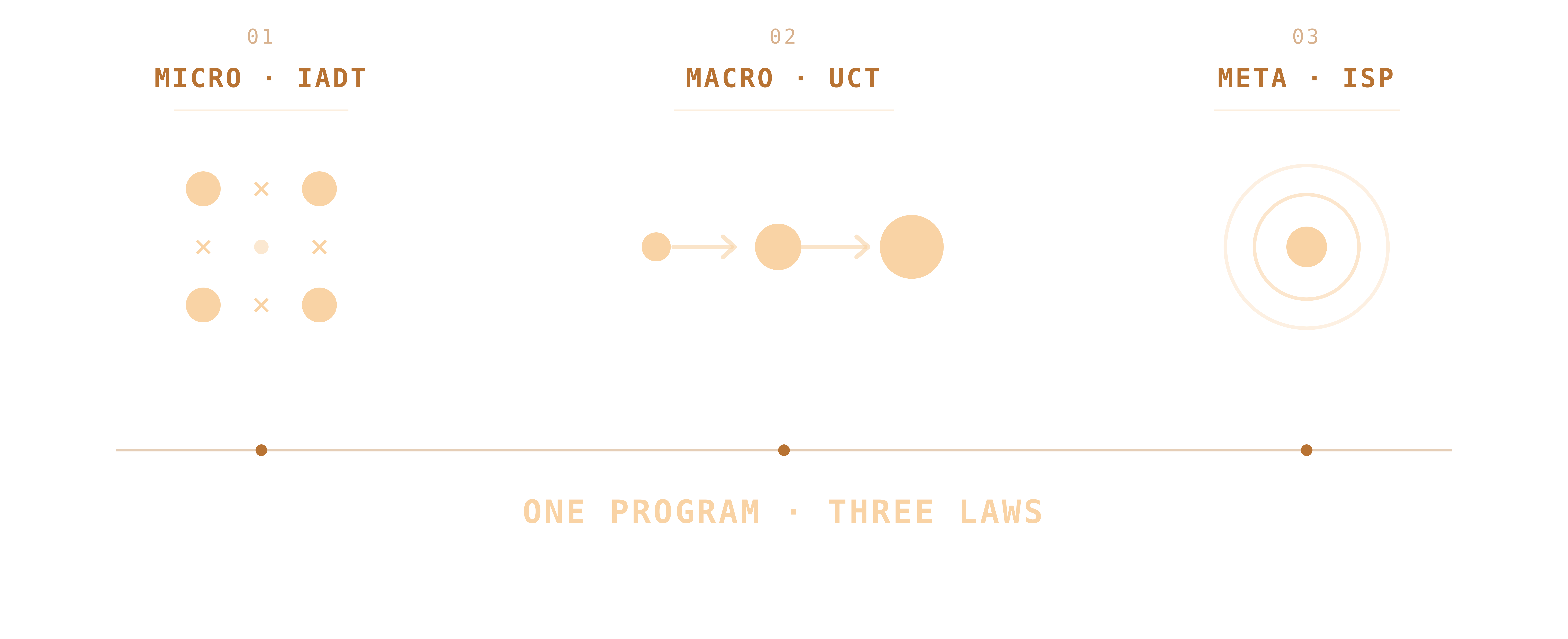
The three laws at the micro, macro, and meta scales, derived and stated formally. Plus the empirical evidence that the multiplicative architecture holds across biological, artificial, and hybrid substrates. Every paper in every other program traces its structural claims back to this canonical core.
The laws tested against the empirical record from every sector, industry, and discipline where humans make decisions. From financial risk to clinical judgement to educational selection to electoral behaviour, the same multiplicative architecture governs the outcome. Every test in the program substantiates the structural finding the foundational program advanced.
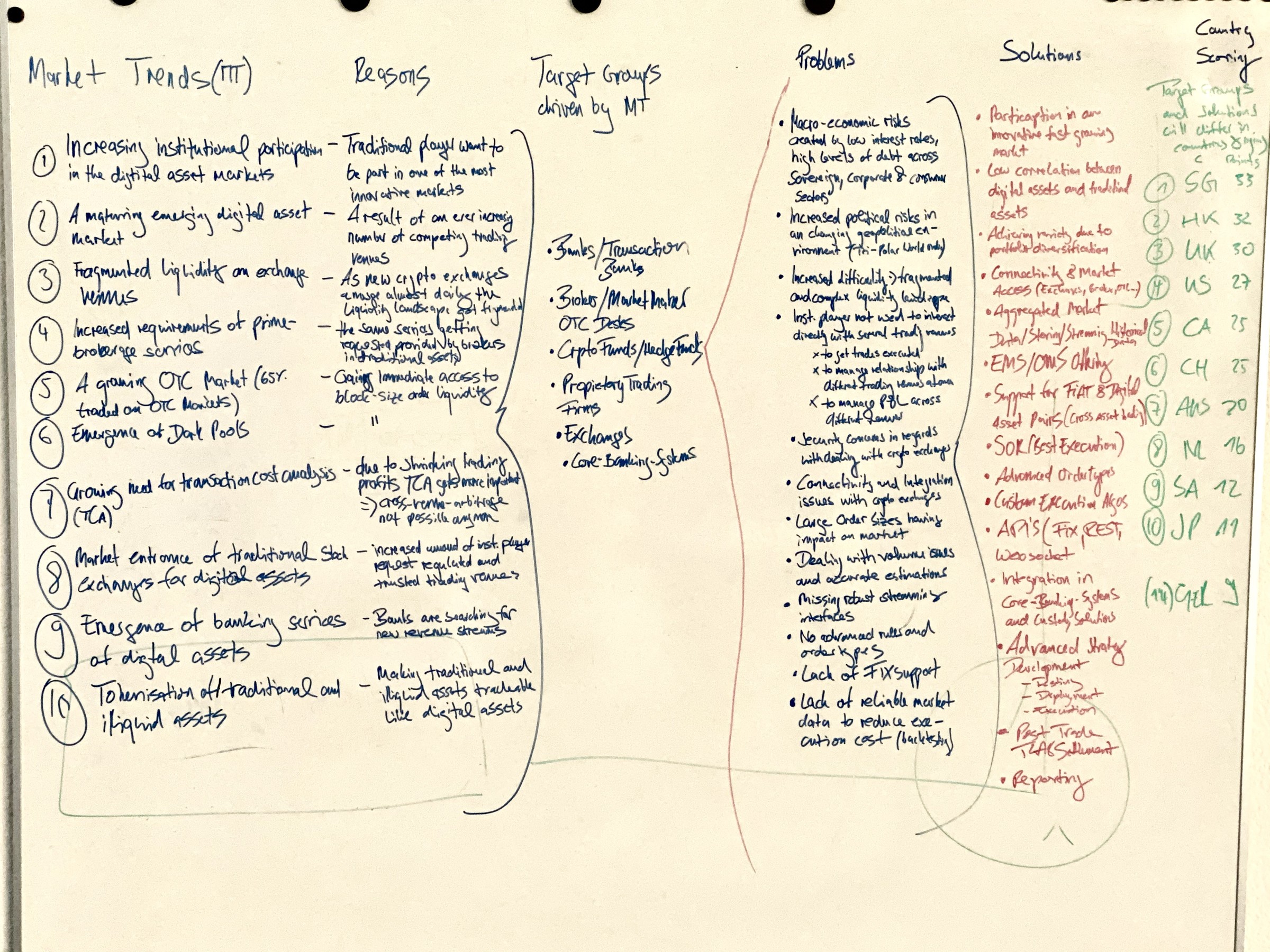
The first sketch of the Three Universal Laws. Drawn four years before any AI language model became publicly available.
Sketched at an office in Zurich. The board maps the direction of the markets, the forces driving them, the audiences they affected, the problems those audiences encountered, and the responses the market was developing. The structural logic that became the First, Second, and Third Laws is already on the board, in the language of practice.
Press, academic peers, conference organisers, policy bodies, industry practitioners, and readers reach the studio here.
Six formats, from public keynote to closed doctoral seminar. The full range is welcome; the substance of the questions decides the invitation.
Four positions, from visiting researcher to fellowship, with two scheduled per calendar year. A residency produces sharper work than a single talk because the conversation extends.
Press kit with bios, headshots, and topic briefs is ready to download. Lectures, learning materials, and the architecture itself are licensable.